J C Forsyth

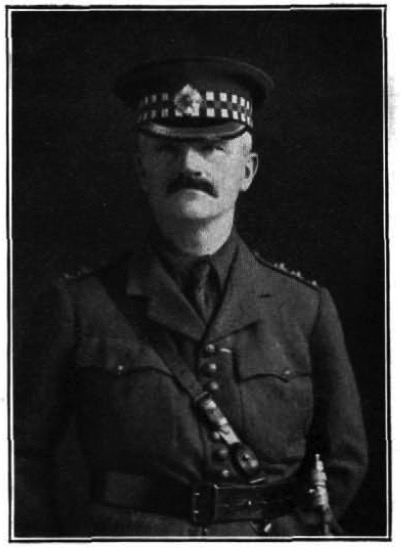
John Cusack Forsyth was one of five brothers and two sisters born to Colonel Frederick Arthur Forsyth and Ellen Sanford Forsyth.

Four of the five boys would be killed in the service of the crown in what has been described as a “real life Private Ryan” story. John’s brother Frederick was a member of the Old Wellingtonian Lodge and Triune Lodge No 2121 (now part of the Grand Lodge of India). 

Of the brothers Arthur was in the Royal Norfolks and died of Malaria contracted in Nigeria on active service in 1909. Sam was a Gunner and was killed in action in France in September 1915. The youngest, Cusack, a half Colonel commanding the 6th Yorkshires was Killed in Action in September 1916. Three brothers killed in consecutive Septembers must have been a heavy weight for the family and for the surviving brother.

John Cusack Forsyth went to Wellington in the Michelmas term of 1897, following three of his brothers (the other brother went to Malvern). He was in the Murray from 1897, as were his Wellington brothers. 

He went on to Woolwich and the RMA. He was gazetted into the RFA in 1902 and served in England and Ireland.

He was described as having a somewhat reserved nature and undemonstrative, he was particularly zealous and painstaking officer, respected by brother officers and men. At home he was well-known as a fine and courageous horseman and rider to hounds, and he was very popular in social circles. 

He was acting as Adjutant to 23rd Brigade when he was killed.

His death was reported as late news in the Coventry Evening Telegraph:

 “WARWICKSHIRE LIEUTENANT KILLED IN ACTION. Lieut. J.C. Forsyth, of Leamington, Adjutant of the 23rd Brigade Royal Field Artillery, was killed in action on the 23rd inst. Deceased was well known in sporting circles in this district. He was the brother of Mr. S.S. Forsyth, solicitor, of Coventry, who is now serving in the same brigade.”

The Leamington Spa Courier provided more detail:

“LOCAL CASUALTIES – Killed Lieut J.C. Forsyth. This week, as last, we record with deep regret the death in action of another Leamingtonian, a member of a well-known family. We feel sure the very deepest sympathy will be felt for Mrs. Forsyth, widow of Lieutenant Colonel Forsyth, in the death of her second son, Lieutenant John Cusack Forsyth, who was killed in action in the batttle of the Aisne on September 23rd. The news was received in London by Mrs. Forsyth last Sunday in a telegram from her son Mr. S.S. Forsyth, who is serving in the 23rd Brigade Royal Field Artillery, of which Lieutenant J.C. Forsyth was Adjutant.”

John Cusack Forsyth was a member of Ubique Lodge No 1789 and regular visitor to this, his brother’s Lodge and that of another OW Lodge member Col Arthur Boileau.


J B B Ford

Captain John Ballard Berkeley Ford Royal West Kent Regiment died of wounds received in action on 18 February 1917.

John was born in Kirkee, India, the son of Majar General Sir Richard Ford KCMG CB DSO and Lady Ford. He went to Wellington from 1902. He was in the Hill.

He went to Sandhurst in 1906 and was commissioned and gazetted to the 2nd Bttn Royal West Kent Regiment in 1908. 

In the Great War he served with the 7th Bttn first in Mesopotamia before going to the Western Front where he was wounded on 14 February 1917. He died of those wounds two days later.

He was initiated into Lebong Lodge No 3321 in Bengal when serving in India and later joined Lodge Light in the East No 1308. 


O A G Fitz-Gerald

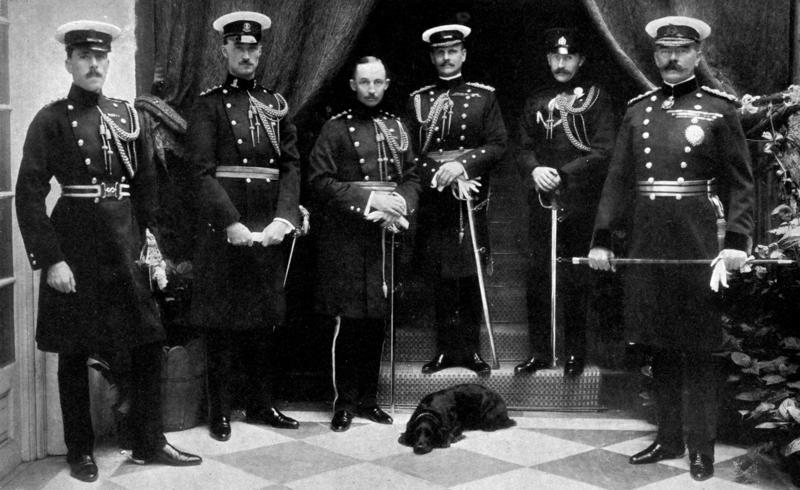
Lord Kitchener and his personal staff in India. Left to right: Lt GGE Wylly, Capt NJC Livingstone-Learmonth, Capt OAG Fitzgerald, Col WR Birdwood, Capt WF Basset and Lord Kitchener.

Fitz-Gerald was a staff officer and confidante of Lord Kitchener who died on active service with him when HMS Hampshire was lost on 5 June 1916 with the loss of 737 hands and passengers. There were twelve survivors.

The son of Colonel Sir Charles Fitz-Gerald KCB and born in Aurungarabad, Madras, Fitz-Gerald was in the Hardinge from 1888 before going ‘over the hill’ to Sandhurst.

He was commissioned and joined the Indian Army in 1895. He was gazetted to the 18th King George’s Own Lancers in 1897.

In 1904 he was made ADC to Lord Kitchener, Commander in Chief in India, until 1906 when he became his Assistant Military Secretary until 1909. He was made GSO 3 in  Egypt before becoming Military Attache (GSO 2) for Egypt, Sudan, and Abyssinia 1912.

“Colonel FitzGerald saved the life of Lord Kitchener in Egypt in 1912. A plot to assassinate Lord Kitchener had been formed, and Colonel FitzGerald having received information about it and having a photograph of the man who was to carry it out, was on the lookout for him, and detected him near the carriage in which Lord Kitchener was riding. Colonel FitzGerald fixed the would-be assassin with his eye and at the same time covered Lord Kitchener, so that had the man fired Colonel FitzGerald’s body would have received the bullet. Fortunately the man hesitated and was arrested.”

1914 saw him return to Lord Kitchener’s service as Personal Military Secretary until 1916, being made CMG in 1915.

He was on the Hampshire in 1916, which was lost with enormous loss of life, including Lord Kitchener. There were only 12 survivors. She hit a mine in Scapa Flow having turned back from the start of her voyage to Russia due to heavy seas. It is believed the mine was laid by a German submarine.

He was one of only two of the victims of the Hampshire whose bodies were able to be buried.

Colonel FitzGerald’s coffin was rested in St. Matthew’s Church, Westminster, where it was strewn with floral tributes from personal friends and other mourners, before being taken to Victoria Station for the journey to Eastbourne.

The coffin containing the body of Colonel FitzGeral, arrived at Eastbourne Station and was transferred onto a gun-carriage drawn by six horses, and driven by officers from the Army Service Corps. A wounded soldier in a bath-chair was seen to support himself against a wall as he stood to attention. Passing along the seafront the procession was watched by crowds who lined the route to All Saints’ Church where the service began. The Bishop of Chichester officiated and the gathering included representatives from the family, foreign delegations and military officers from many regiments and corps. Those accompanying the coffin to the grave formed up outside the church and processed to Ocklynge Cemetery, where the coffin was interred and several volleys fired over the grave.

British Pathé have footage of the funeral:


In the first sequence the ASC officers can be seen riding the three drive horses and sitting on the limber pulling the gun carriage. The coffin is draped with a union flag and soldiers in hospital uniforms are marching in front, presumably the contingent from Summerdown Convalescent Hospital that were mentioned in the Times report? Officers from the foreign delegations can be seen following the coffin.

The second sequence at Ocklynge shows, in close up, most of the military mourners. Capitaine Jean de Vigurie, of the French Army, and Colonel Count Greppi, of Italy, are both resplendent in their exotic, well pressed, uniforms, standing out against the rather shabby khaki dress of the British Army officers. Count Greppi a tall man, with a waxed moustache, appears like a giant in his high crowned conical cap. One, rather gaunt looking, Naval officer follows the coffin. This is Commander Kitchener, RN, the Great Man’s brother. There are many soldiers, with arms reversed and heads bowed, along the path to the grave.

The final sequence shows long lines of soldiers, possibly from the Eastbourne College Officer Training Corps, firing over the grave. At the end of the closing shot two horses, frightened by the rifle fire, gallop across a field behind the cemetery.

———-

FitzGerald, in his capacity at Kitchener’s Military Secretary was accompanying him on a delicate mission to support the Imperial Russian war effort. The detail remains less clear, but given the composition of the team the mission seems also to have a more detailed purpose in trying to set up a more industrialised and efficient ammunitions and armaments manufacturing process to supply the Eastern Front. Kitchener had himself been Minister of Munitions in 1915 when he and the department were blamed for the lack of HE shells being supplied to the Western Front.

Lord Kitchener’s principal companions on his mission to Russia were Sir Hay Frederick Donaldson, an Australian who was Chief Technical Advisor to the Ministry of Munitions; Lieutenant-Colonel Wilfrid Ellershaw (a Temporary Brigadier-General), an Artillery officer who had been an instructor at the Royal Military Academy; Mr Hugh James O’Beirne, an Irish career Diplomat and Government Minister; Lieutenant-Colonel Oswald Arthur Gerald FitzGerald, an Indian Army officer and Kitchener’s Military Secretary; and, Mr L.S. Robertson, Assistant to the Director of Production at the Ministry of Munitions. 

HMS Hampshire was one of six Devonshire-class armoured cruisers built for the Royal Navy in the first decade of the 20th century.

Due to the gale-force conditions, it was decided that Hampshire would sail through the Pentland Firth, then turn north along the western coast of the Orkney Islands. This course would provide a lee from the strong winds, allowing escorting destroyers to keep pace with her. She departed Scapa Flow at 16:45 and about an hour later rendezvoused with her two escorts, the Acasta-class destroyers Unity and Victor. As the ships turned to the northwest, the gale increased and shifted direction so that the ships were facing it head on. This caused the destroyers to fall behind Hampshire. As it was considered unlikely that enemy submarines would be active in such conditions, Captain Savill of the Hampshire ordered Unity and Victor to return to Scapa Flow.

Sailing alone in heavy seas, Hampshire was approximately 1.5 miles off the mainland of Orkney between Brough of Birsay and Marwick Head at 19:40 on 5 June when an explosion occurred and she heeled to starboard. She had struck one of several mines laid by the German minelaying submarine U75 on 28–29 May, just before the Battle of Jutland. The detonation had holed the cruiser between bows and bridge, and the lifeboats were smashed against the side of the ship by the heavy seas when they were lowered. About 15 minutes after the explosion, Hampshire sank by the bow. Of the 735 crewmembers and 14 passengers aboard, only 12 crew survived after coming ashore on three Carley floats. A total of 737 were lost including Kitchener and all the members of the mission to Russia.

He was initiated into Kitchener Lodge No 2998 in northern India, in a rapid series of of meetings  he was initiated in June 1906, passed later the same month and raised in August. 

He later joined McMahon Lodge No 3262 in London and Lord Kitchener Lodge No 3402 in Cyprus.


C Coles

Crewe Coles Coles was the third son of C E Coles Pacha CMG the Inspector General of Prisons in Egypt and of Mrs Coles of Stone House, Bishop’s Hull, Taunton.

He was educated in Eastbourne and at Cheam School before going to Wellington.

He was in the Lynedoch from 1904 before going up to Jesus, Cambridge and taking his degree. He rowed for Jesus in the Lent Races and was Head of the River.

“Coles (11st 5lbs) was a committed oarsman and won head of the river in Lent Bumps 1909, rowing at No 2 in the same boat that T. M. Crowe (another Gallipoli casualty) stroked. He also rowed at the Henley Regatta in the Ladies’ Plate and Thames Cup.” (Jesus College Boat Club Records)

“Coles also took part in a couple of athletics events, taking part in the 120 yards hurdle race and the high jump. In the December 1908 College Sports event he recorded a height of 5ft 2½in, which was some way off the Olympic Gold Medal height in the 1912 games at 6ft 3in” (Jesus College Society Annual Report, 1909, p36).

He was initiated into Isaac Newton University Lodge No 859, the lodge of the University in 1908. Isaac Newton was a popular lodge among OWs with Raphael, Bryant, Van Duzer, Larmour, Stoney and Stephenson all being members.

He joined Grecia Lodge No 1105 upon coming down from Cambridge.

His other great passion was Borzoi hounds. His obit recorded that “He was a gentle but manly youth. His friends might like to know that his grand Borzoi which accompanied him on his walks died this year” (Jesus College Society Annual Report 1915, p32). The College believes that he kept his Borzoi in the College Stables owing to its size; Dogs were not allowed in College.

He volunteered in 1915 and was commissioned into the East Lancashire Regiment.

Serving with the 4th Bttn the East Lancashire Regiment at Gallipoli he fell at Gallipoli on 4 June 1915, shot while leading his mean in an attack on the Turkish trenches in front of Krithia.

The Brigadier-General commanding 126th Brigade wrote of him as follows:

“I personally held the highest opinion of him and his capabilities. He behaved with great gallantry and was conspicuous throughout this action. He led his men on gallantly, and they followed him. He was amongst the troops of this division who reached bang up to and into the enemy’s rearmost trenches. In fact, I am told that a portion of the attack reached Krithia, but owing to other parts of the attack not being able to get as far, they had to fall back to the general line. His Colonel and the regiment deeply regret his loss, as I do. I had marked him down for special mention. Gallipoli, June 27th.”


R A Bostock

Surgeon Captain Robert Ashton Bostock LRCP MRCS RAMC died on active service 17 August 1917 aged 57.

Bostock was the son of Deputy Surgeon General J A Bostock CB Scots Guards and the grandson of Dr Bostock FRS. He married Caroline Mary Haden in 1895.

He was in the Orange from 1874. He trained at Bart’s and was made LSA of London in 1885, MRCS of England the same year and LRC of the Physicians in London in 1887.

He became Honorary Surgeon to Queen Victoria and a Surgeon Captain to the Army Staff in 1886. He became Surgeon to the Scots Guards like his father before him in 1887, serving the 2nd Bttn for 11 years and served as Surgeon to the General Staff during the Boer War.

He retired in 1901 and move into General Practice in Glamorgan and became a JP.

On the outbreak of the Great was appointed to the Central Recruiting Depot at Scotland Yard. He was then appointed President of the Shoreditch Medical Recruiting Board. He was Mentioned early in the War.

He died of natural causes in London and is buried at St John the Baptist Churchyard, Penmaen, Wales.

He was initiated into Aldershot Army & Navy Lodge No 1971 in 1887, and joined the medical lodges  Rahere No 2546 and Aesculapius No 2410. He was a founder of the Old Wellingtonian Lodge’s mother lodge Household Brigade Lodge No 2614 in 1896.

His son followed his father into the Orange from 1911 to 1916. 

A A Steward

Lieutenant the Reverend Arthur Amyot Steward RFA was killed in action on 6 October 1917 at the Battle of Passchendaele when an enemy shell destroyed the bunker that was his observation post.

The son of the Reverend Canon Edward Steward, Arthur was in the Murray from 1897. After Wellington he volunteered for the South African War with the Norfolk Militia.

On returning from South Africa he went up to Magdalen College, Oxford and took his degree, before following in his father’s footsteps and seeking ordination.

Whilst he was up at Magdalen he was initiated into the Apollo in 1909.

He went to Wells Theological College in 1911, and was ordained and appointed Deacon and Curate of St Paul’s Southcoates, Hull in 1912.

He returned to South Africa under church colours to minister to the miners in Johannesburg.

On the outbreak of war he returned to England offered his services to the Army once more. Commissioned into the Royal Field Artillery he later transferred to the Royal Flying Corps as an observation officer.

He was attached to No 11  Balloon Company when he was killed in action.

He is buried at Dunhallow ADS Cemetery at West-Vlaanderen, Belgium.

J L Bevir

J L Bevir

“The most devoted son of Wellington”1

Joseph Louis Bevir was an OW, having been in the Hardinge from 1870 and the winner of the Kingsley in 1874, the cross-country race still run annually at Wellington. He became an Assistant Master and later Housemaster of the eponymous Bevir’s House, later the Benson, and an author.

It is difficult to imagine a Wellington without the influence of Bevir, although at first glance many will not realise his impact. He is probably best known by Wellingtonians for his book on the early years of Wellington called “The Making of Wellington College; Being an Account of the First Sixteen Years of its Existence”. He went on to write several other books including Visitors Guides to Orvieto (1884) and then Siena and San Gimigniano (1885) and edited several other texts.

Whilst teaching at College he became a housemaster in the days when the Houses were named after their masters; the Benson was “Bevir’s House” for some twenty years.

During the First World War he was Vaughan’s Senior Assistant Master and even ran the school for a term in 1918 during Vaughan’s illness.

On retiring from the Senior Common Room, he helped found the OW Society, becoming Hon Secretary, President, and the first editor of the Year Book, a post he held for thirty years. “In 1885 he played a large part in the establishment and early organisation of the Wellington College Mission in Walworth (now the Crowthorne Trust)… and in the acquisition of the Derby Field” on behalf of fellow Lodge member Lord Derby.

It is in his memory that the Bevir Trust was founded, which today is largely used “to assist young OWs with the cost of character-developing and socially desirable projects”. Whilst in no way related to the Lodge other than as a beneficiary of our charitable distribution, every mason will appreciate the values of this mission and the Lodge has supported the Trust on many occasions.

Bevir was another member of Wellesley Lodge No 1899, but was only an Entered Apprentice, before joining the OW Lodge. We were fortunate indeed to have the privilege of passing and raising this son of Wellington.

He joined the Lodge in 1910 alongside 4 fellow brethren, a pair of 9th Lancers Lord Dorchester and Brigadier General Frederick Cavendish, Lt Col Patrick Stoney of the 26th Punjabis and brother of Thomas Stoney, and his fellow member of Senior Common Room The Revered William Brown.

1. A history of Wellington College, D Newsome. Pg 222

M Quayle Jones

Brigadier Morey Quayle Jones CB CMG CBE DL was a Founder of the Lodge. He was born in 1855, the son of a vicar and went to Wellington in 1870 with two other founders, Bros Haines and Edgell, and a later joining member, Bro Bevir. He was in the Orange.

Quayle Jones was commissioned into the 6th of Foot in 1873, later the Royal Warwickshire Regiment, making Captain ten years later. 1884 saw him serving as a Major with the 4th Pioneer Bechuanaland Field Force and 1898 saw him with the Nile Expedition as part of the Second Sudan War re-treading the paths of Dalgety and company.  

In between these African adventures he found time to study for and be called to the Bar. The Army was not a reliable nor consistent employer in those days (or indeed still, some might argue) and unless there were battles to fight, barracks life and half pay were not a tempting proposition. Unfortunately no record remains of his legal career.

From 1891 to 1894 he was commandant of the School of Instruction for the Auxiliary Forces at Aldershot and by 1898 he was back in his regiment, in Africa and in command.

On the Nile Expedition of 1898 and still a Major, Quayle Jones temporarily commanded his regiment as a result of an early posting for the outgoing Commanding Officer and late arrival of his successor, just long enough for Quayle Jones to see the 1st Battalion through the battle of Atbara.

Tasked with retaking the Sudan from the self proclaimed Mahdi, Osman Digna, (Bro) Lord Kitchener ordered his combined Anglo-Egyptian force to attack the unusually reticent Mahdi forces at Atbara. The Warwickshires under Quayle Jones held the left flank and were charged with protecting it from the Mahdi Cavalry.

The regimental history tells of a short, hard fight:

 “at close quarters amid the trenches and huts within the enclosure. But the British, breaking in at the north-eastern end, enfiladed the enemy with their terrible rifle fire, and the whole force, advancing steadily, drove the Dervishes in hopeless confusion to the river bed.”*

The reality can only be guessed at amid a typical example of stiff-upper-lipped understatement. For his part Quayle Jones was given the Order of the Bath and welcomed Colonel Forbes, the overdue CO, the next day. All in a days work. Forbes must have rued his delay.

In 1901 he joined many of the brethren, other OWs and his comrades in South Africa but his stay was brief as the same year saw him despatched to Bermuda as Assistant Adjutant General for Prisoners of War, a harder posting than modern reading would at first suggest, a time before modern medicine.

He returned home safely and after retiring in 1909 became Deputy Lieutenant for Warwickshire and Assistant Provincial Grand Master for the Province, and still found time to be a founding member of our Lodge.

He had been initiated in Alderney into Doyle’s Lodge of Fellowship No 84, and was a joining member of Aldershot Army & Navy Lodge No 1971.

Civilian life was not going to be allowed to keep him when in 1914 the Great War saw him return to the colours commanding first the 104th Infantry Brigade from 1914-1915 and later the 11th Reserve Brigade in 1916.

He was made a CMG in 1917 and a CBE in 1919.

He died in 1946, aged 91.

* CH. XV, Pg 109-115: ATBARA AND KHARTOUM, 1898. The Story Of The Royal Warwickshire Regiment. C. L. Kingsford

The image above shows him at the centre of the group with the Royal Warwickshire’s regimental mascot, Bobby.

Armistice Meeting: Victoria Rifles Lodge No 822

The Old Wellingtonian Lodge would like to pay tribute to the Worship Master and Brethren of Victoria Rifles Lodge No 822 for the wonderful and moving tribute paid to the fallen at the Armistice Day meeting held in Grand Temple on 10 November 2018. 

In particular the brethren would like to commend the leadership of one of our own, W Bro James Milne who served as Master of Victoria Rifles for the years either side of the meeting.

London Grand Rank

The Lodge would like the congratulate all those receiving London Grand Rank in November, including our very own Mentor, W Bro Simon Wilson on his appointment.