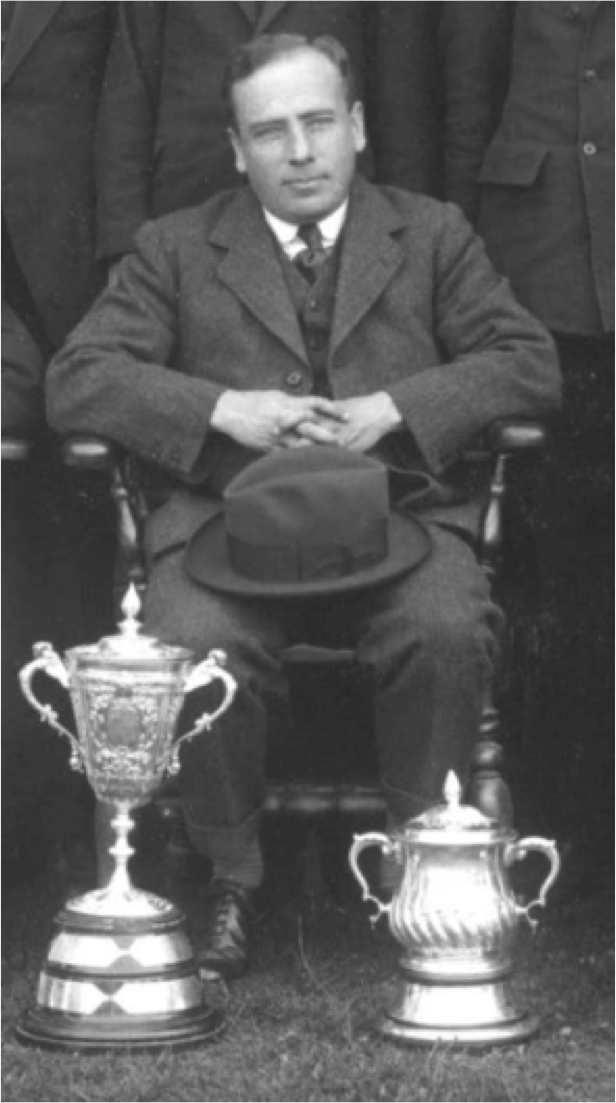
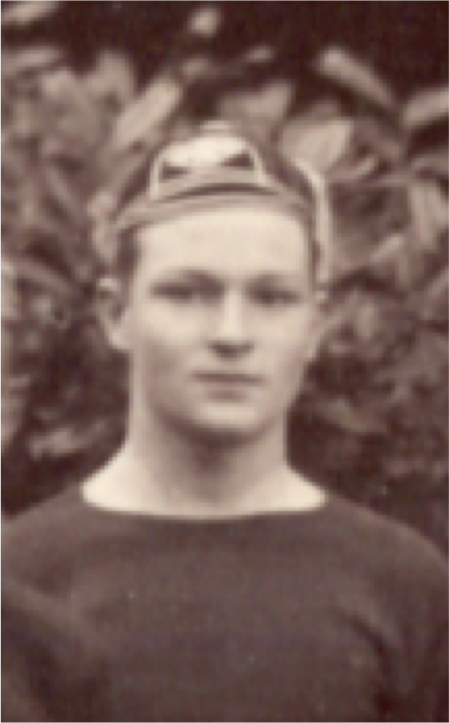
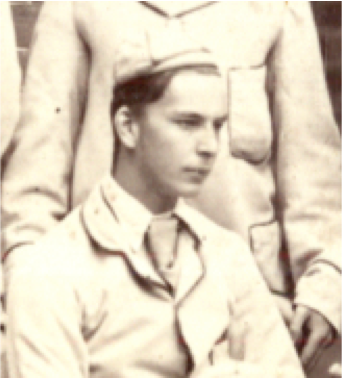
Lt Colonel Clive Wilfred Salter QC was in the Hill from 1915 and was made a Prefect. He went up to New College before being called to the Bar, later taking silk.
The post war years saw him in Kenya as a most successful advocate in the Kenya Courts, and he was elected to public office. He was also Chairman of the Muthaiga Country Club for many years. Writing in the 1991 Yearbook, Sir Michael Blundell provided a pen picture of many OWs in Kenya throughout the 20th century, and concluded none too seriously that “in later life [Salter] was immensely corpulent and toiled until his death maintaining a succession of broken marriages”!
He was Worshipful Deputy Master in 1938, and stayed on for a second year as the war clouds turned into the real thing.
He served as a Territorial Officer, who served largely with the ACF.
The Revd A C ‘Teddie’ Larmour Courtesy of Wellington College Archive
The Reverend Alwin Corden ‘Teddie” Larmour was a schoolmaster at Wellington who joined the Lodge in 1911, and was Deputy Master in 1936. He held the office of Chaplain of the Lodge for many years. He was also a Provincial Grand Chaplain.
He taught at Wellington from 1909 to 1943, and in the recollections of another member of the Lodge, his classroom was down by Green Quad underneath ‘Siberia’. He commanded the OTC (now CCF) for which he held the rank of Captain. He was also a Local Councillor in Berkshire.
His other great passion was philately. He was a member of the Royal Philatelic Society London, like his father and uncle before him and he edited The London Philatelist in the early forties, credited with keeping it going during the war despite the obvious issues, and even despite the print works being subject to a direct hit from enemy bombing.
He died at his home, ‘Dunroamin’, in Crowthorne in 1946.
Reginald Herbert Nourse was born in 1883. He was in the Lynedoch with future fellow Lodge member John F C Carter and Harry Chubb (see below). He became a broadcaster and journalist.
He was initiated in 1923, served as Deputy Worshipful Master in 1935 and served the Lodge until his death in 1951.
Lynedoch 1898 RH Nourse, HE Chubb & JFC Carter Courtesy of Wellington College Archive
Warren Turner Peacock was initiated into the Lodge in 1912, and became Worshipful Deputy Master in 1932. He was made AGDC by Grand Lodge. He was also a long time member of Harmony Lodge No 275 in Huddersfield and was their Master in the late Twenties.
He was born in 1876, and came to Wellington in 1890, before going up to Jesus College Cambridge. He became a solicitor in Surrey, and served as a Territorial Officer with the RASC in the Great War. He was in the Hill, whose dormitory photograph on 1891 is the source of the fresh faced 15 year old Peacock below.
Ralph William Dershon Sandford came to Wellington and the Hardinge in 1901, before going up to Pembroke. He became a solicitor in London. He was a Territorial Officer with the East Surreys.
He was initiated into the Old Wellingtonian Lodge in 1918, and served as the Lodge’s Deputy Master in 1931, and again as Worshipful Master in 1948. He was a member of the Lodge for 64 years, the longest of any member alongside the Founding Father of the Lodge, Brigadier Weston.
R W D Sandford Hardinge 1902 Courtesy of Wellington College Archive
Harold Charlesworth Powell was initiated into the Lodge in 1917 and became Worshipful Deputy Master in 1924
He went to Wellington in 1888, and was in the Wellesley. He was a Prefect. After Wellington he went to London and worked in Insurance, with the Eagle Insurance Company and later with the Equitable Life.
He was a territorial officer with the Queen’s Westminsters, along with Sidney Savill, who had been in the same house, albeit some years later.
Arthur Cadell Tait Boileau was the only boy from 1871’s intake at College to have joined the Lodge. He was in the Orange.
“The only surviving son of General Alexander Boileau of the Bengal Engineers, Arthur was born in India a few weeks before the Mutiny broke out and could not leave that country for two years. He served with the Royal Artillery for nearly 32 years at home and at India, Egypt, Baluchistan, Nova Scotia, and Mauritius. He was for five years secretary of the Royal Artillery Institute at Woolwich.”1 He was on the Board of Health in Woolwich, and his name even appears on the foundation stone of the Woolwich Public Library.
He joined the Gunners’ lodge, Unique No 1789 in 1894, was Worship Master there in 1901, and joined the same Chapter, becoming First Principal the following year.
A M Latham (Detail from XV 1879) Courtesy of Wellington College Archive.
Alexander Mere Latham was in the Talbot from 1877, was in the XI, captained the XV in 1880, and was made a Prefect before going up to BNC to read law. He was the father of the Lodge’s first Lewis, George Latham.
He was called to the Bar at the Inner Temple in 1890. He was the Recorder of Birkenhead from 1912 to 1934.
He was a Founder of the Lodge, Worshipful Deputy Master in 1915 and served as Secretary between 1919 and 1931. He remained a member until his death. Latham was initiated into the Playgoers Lodge No 2705, and joined that Lodge’s Chapter. He was given London Rank in 1918. He was made Assistant Grand Registrar in 1923. He was also a member of Oxford and South Eastern Bar Lodge No 2716.
His other great passion was sport, and in particular cricket. He played both football and cricket for Cheshire, and was a member of the M.C.C. and the Surrey County C.C. After he was too old to play, he was for many years a stalwart umpire of the OW match.
H A Haines (Capt XI 1877). Courtesy of Wellington College Archive.
Hermann Anderson Haines was born in Bombay in December 1857 and was sent back to England to Wellington in 1870. He was in the Hopetoun, made Head of College in 1878, captained the XI and in the Rackets Pair.
He came fifth in the notoriously difficult Imperial Engineering College (Cooper’s Hill) exam, but instead took a a Scholarship to Keble, where he captained the College XI and only narrowly missed out on a Blue.
In 1881 he passed first into the Home Civil Service and went to the India Office. He served in the Financial and Political Departments before going in 1903 as assistant-secretary to the Public Works Department, of which he became head eight years later.
One of the surviving pieces of his work from the India office is the border that was drawn between Persia and Baluchistan, now Iran and Pakistan, which centred on the town of Mekran. A copy can be viewed on the Qatar National Library website.
He was initiated into St. George’s Lodge No 370 in Chertsey in 1901, and joined that lodge’s chapter soon thereafter. He was made both Provincial Junior Grand Deacon and Provincial Grand Sword Bearer in Surrey in 1911.
He was a Founder of the OW Lodge and became our sixth Worshipful Deputy Master in 1914.
He was also for many years a member of Wellington’s Walworth Mission Council. His chief recreation was fishing, usually in Scotland or Ireland, being a man who lived a somewhat secluded life. His practical benevolence, which showed itself in the interest which he took in the numerous boys whom he helped to start in life, was known only to his most intimate friends.
Frederick Blagden Malim was Master of Wellington College from 1921 to 1937, and Deputy Master of the Old Wellingtonian Lodge in 1923. He was the first Master of Wellington to be Master of the Lodge, but not the last.
Malim was a scholar at Trinity College Cambridge, having “won an open scholarship at Clare College, Cambridge, but preferred to go the following year to Trinity College, where he matriculated in 1891. He became a scholar in 1892 and won first classes in both parts of the classical tripos (1894 and 1895). He came close to winning a Trinity fellowship with a thesis on Plato’s Phaedo, and he was president of the union in Michaelmas term 1894”1 before embarking on a career as a schoolmaster, specifically divinity. He became an assistant master and then a housemaster (B8) at Marlborough. From there he headed north to become Master of Sedbergh before returning south to the mastership of Haileybury and ultimately, Wellington. He was chairman of the Headmasters’ Conference in 1932 and 1935.
He was described as “the last Victorian Master of Wellington, compact, grey-haired, square-jawed, a figure of awe. His last sermon in College Chapel was a scene from an old-fashioned school story. ‘Quit you like men!’ he announced” which would be imitated by Old Wellingtonians around the Empire: Quit… You… Like… Men…!.”
He was not unremittingly Victorian however, in his criticism of the Common Entrance he wished prep school master would teach boys as well as latin. He was also a pacifist, an interesting qualification for the mastership of this School. He was one of those thought to have originated the monkey of “that Hell over the Hill” for the Royal Military College, Sandhurst. He also pioneered a transatlantic relationship with Andover Academy, whose first exchange student, one F W Griffin broke every swimming record Wellington had, an returned with “a bastard English accent”. Revenge was gained when Wellington sent Richard Stoker on the return leg, where he he made a hole in one at North Andover Country Club’s fifth and was elected to cum laude and won six senior honors in his studies, more than anyone in his class.2
In fact his legacy at Wellington away from those four oft-repeated words was one of renewal and moderation: “The Wellington years were the period when his talents found their fullest expression. His policy during the difficult inter-war years was to keep the numbers high and the fees low while steadily improving the facilities. The boarding-houses were renovated and new science laboratories built. He was prepared to liberalize the atmosphere of the school, and he dealt sensibly and moderately with the activities of the communist-leaning Romilly brothers, Giles and Esmond, who inserted pacifist leaflets into all the hymnbooks on Remembrance day 1933.”2
Perhaps the final words should be left to his obituary in The Times ‘he was one of the foremost headmasters of his time and his advice was constantly sought by younger men who became headmasters, as well as by parents’.
Oxford Dictionary of National Biography John Roach, ‘Malim, Frederic Blagden (1872–1966)’, online edn, first published Sept 2004.
CLAUDE M. FUESS, Independent Schoolmaster, Little, Brown and Company Boston, 1952
Oxford Dictionary of National Biography. Ibid
This website uses cookies to improve your experience. We'll assume you're ok with this, but you can opt-out if you wish.AcceptRejectRead More
Privacy & Cookies Policy
Privacy Overview
This website uses cookies to improve your experience while you navigate through the website. Out of these, the cookies that are categorized as necessary are stored on your browser as they are essential for the working of basic functionalities of the website. We also use third-party cookies that help us analyze and understand how you use this website. These cookies will be stored in your browser only with your consent. You also have the option to opt-out of these cookies. But opting out of some of these cookies may affect your browsing experience.
Necessary cookies are absolutely essential for the website to function properly. This category only includes cookies that ensures basic functionalities and security features of the website. These cookies do not store any personal information.
Any cookies that may not be particularly necessary for the website to function and is used specifically to collect user personal data via analytics, ads, other embedded contents are termed as non-necessary cookies. It is mandatory to procure user consent prior to running these cookies on your website.