Surgeon Lieutenant Dr Norman Clifton Carver MB MRCS LRCP was born in 1876, and went up to Wellington in 1890 to the Hill.
He trained at King’s and become a house surgeon at St Thomas’s going on to become Senior Obstetrical House Physician. He served in the Royal Navy during the Great War as a Surgeon Lieutenant, and was mentioned in dispatches. He was both published and called upon for expert testimony in major cases, testing to the high regard in which he was held.
In retirement from hospital surgery he became a member of the Executive Committee of the Central Council for the Care of Cripples in England. This rather blunt title hid an important post war organisation that tended to to needs of those crippled in the Second World War, both military and civilian. It was formed boy the Ministry of Health, the Board of Education and the Invalid Children’s Aid Association. Orthopaedics was a central part of its works, and also one of Carver’s specialisms.
He was initiated into Cheselden Lodge No 2870, the Lodge associated with St Thomas’s Hospital (see AMULL’s website for more on medical lodges), and later joined St. Margaret’s Lodge No 1872 near his home in Surrey. He was exulted into Burton Court Chapter No 3864 and became a member of St Margaret’s Chapter No 1872. He was made a Provincial Grand Deacon in Surrey. However the 43 years he served the OW Lodge including the Deputy Mastership in 1929 were both his longest masonic commitment and his only Mastership of a Lodge.
Brigadier-General Percy Thuillier Westmorland CMG DSO was born in 1863 and went to Wellington in 1877, the same year as fellow Lodge Founders Alexander Latham and Dighton Pollock (of the Bridge…). He was in the Orange. Westmorland was the son of Colonel J.P Westmorland RE and the late Rose Julia, eldest daughter of the late General Sir Henry Thuillier CSI RA, and wen into the family business via Sandhurst.
He was initiated into Rokell Lodge No 2798 in Freetown, Sierra Leone in 1901, where he was also passed and raised, whilst serving there on The Gambia Expedition. He was one of the Founders of the OW Lodge in 1909. He was also a joining member Khyber Lodge No 582 then in Peshawar, between 1908 and 1910. That Lodge now meets at Duke St in London.
In one of those small but satisfactory coincidences, his name appears on the lists of generals serving in the Great War next to his fellow Founder S V P Weston.
He was a member of the ‘Senior’, the Athenaeum and the Baldwin.
Westmorland was commissioned into the Bedfords, and promoted Captain in 1889. He was transferred to the West India Regiment in 1892 and employed with the Army Pay Department between 1894 and 1897.
He served on the West Coast of Africa 1894, with the Expedition of the Gambia against Fodey Silah (Despatches London Gazette, 4th May 1894), and with the Ashanti Expedition (1895-96). Promoted Major in 1897 he served in the South African War (1899-1900). He became a Staff Officer in Glencoe and commanded St Helena. He returned to West Africa 1901 with the Expedition of Gambia.
He served on the North-West Frontier of India, 1908 and took part in the operations in the Mohmand country, for which he was mentioned in Despatches, and was created a Companion of the Distinguished Service Order (London Gazette 14th August 1908): “In recognition of (his) services in connection with the recent operations against the Zakka Khel and Mohmands”.
He retired a Major in 1912 only to return two years later. He served in the European War from 1914-16, for which he was mentioned in Despatches and was created a CMG in 1916. He was Brigade Commander in 1916, and joined the Territorial Force Reserve in 1918, as Lieutenant-Colonel. He commanded two separate battalions on the Western Front, the 19th London in 1912 and the 1/5 Lincolnshires in 1915.
He was one of the 134 descendants of the Rev C Cardew DD (1747-1831), Rector of St. Erme in Cornwall, who served in the British forces in the Great War.
His DSO was awarded for the action near Matta Mughal Khel, April 24th 1908, Whilst the left column under Colonel Unwin was occupying the attention of the right flank of the Mohmand position, General Anderson’s right column was going into action near Matta. Here up to 8000 tribesman (mainly from the Baezai clan) had constructed a series of strong sangars stretching for about one and a half miles along a line of low foothills.
The right column made up of 1150 infantry drawn from six different corps included 300 men from the 1st Royal Warwickshires under the command of Major Westmorland. They prepared to advance up the slopes to the west. The slopes were covered with flags and sangars of the tribesmen who were clearly present in great strength along a front of one and a half miles.
Anderson brought forward all of his infantry in line and prepared to attack. The action began at 7am and lasted until 10.20am. Anderson’s orders forbade him from doing anything more than driving the enemy to his right as the dominating feature, he ordered the men of the Warwickshire Regiment under Major Westmorland to seize the knoll and clear it.
The general advance had not progressed very far when the tribesmen opened a heavy fire, the Royal Warwicks charged straight on their objective, the small hill, pushing parties up the slopes, then collecting together in an area of dead ground near the crest before rushing the summit with fixed bayonets and taking the hill. Eventually the position was won and the tribesmen fell back into the hills towards the Burjina Pass after having received- and given out- a fair degree of punishment.
Source: Frontier and Overseas Expeditions from India, Volume 1, pages 37,38,39
Major Desbrisay Blundell Mein DSO MC was initiated into the Lodge in 1927 and became Worshipful Deputy Master in 1934.
He went to Wellington and the Lynedoch in 1903, before Sandhurst and the Indian Army. He served with the 55th (Coke’s) Rifles, an Indian Army rifles’ regiment universally known as ‘Cokies’.
He served in France throughout the First world war and was awarded the MC at Ypres as part of the same action with the 4th Bttn 13th FF that saw Jemadar Mir Last win the VC. Mein was the Quartermaster and had sought to protect his men from the early use of gas by the enemy by using chloride of lime to improvise some measure of protection. He preferred “the firing line” to his “routine duties”1 as befitted a rifles officer from the NW Frontier and was alluded to in his MC citation:
“Lieutenant Desbrisay Blundell Mein, 55th Coke’s Rifles (Frontier Force), Indian Army Near Ypres, during operations from 24th April to 4th May, 1915, he displayed the greatest ability and coolness in bringing up rations and ammunition for the regiment under heavy shell fire. When only two officers were left with the regiment he came up from behind and took part in the second attack on the 27th May. He divided his time between assisting in the front line, where be was of the greatest help, and going back through Ypres under heavy shell fire to arrange for rations.”2
Peacetime saw him back in the East, and 1919 saw him as second in command of his battalion in Afghanistan, as with many British Soldiers before and since then, for which he was made a DSO in January 1920. Later that year he received a further Mention for his actions.
He retired to the UK and in civil life, his interest in photography led to his becoming a director of Ilford Ltd, and he was also a director of Schweppes and other companies. and died in Hertfordshire in 1937.
The Yearbook recalls “No one was more interested in or fond of Wellington than Mein; he hardly missed a London O.W. Dinner after he retired from the Army, always wanted to know the news, and when he made criticisms, they were as kindly as they were just.” In the same publication, the Lodge remembered him as “one of the most popular masters that the Lodge has had”.
Regimental History of the 4th Battalion 13th Frontier Force Rifles (Wilde’s)
John Campbell Inglis was one of two pairs of brothers who helped found the Old Wellingtonian Lodge, along with his brother Henry Alves Inglis, and Freeling and Frederick Lawrence.
John had been initiated in 1897 into Royal Somerset House & Inverness Lodge No IV, one of the two ancient and time immemorial Lodges that head the list of lodges in England. He became Master of No IV in 1906. Being a Red Apron Lodge they nominated him as their Grand Steward in 1907 and he went on to become Grand Junior Deacon in 1911. He served the OW Lodge for 36 years.
He went on to help found Doneraile Lodge N 3558 in 1911 and was a joining member of Connaught Lodge No 3270. He also joined No IV’s Chapter, and was a member of the PSLC Chapter.
Inglis went to Wellington in 1880 to the Stanley and was made a Prefect, before going up to New College, Oxford. He graduated and became a solicitor in the City.
Inglis present a Silver Mounted Snuff Horn engraved with Masonic Emblems to Royal Somerset House & Inverness Lodge No IV in 1915 which can be seen at the Library & Museum of Freemasonry at Freemasons Hall in London. It is one of nine items held there from him.
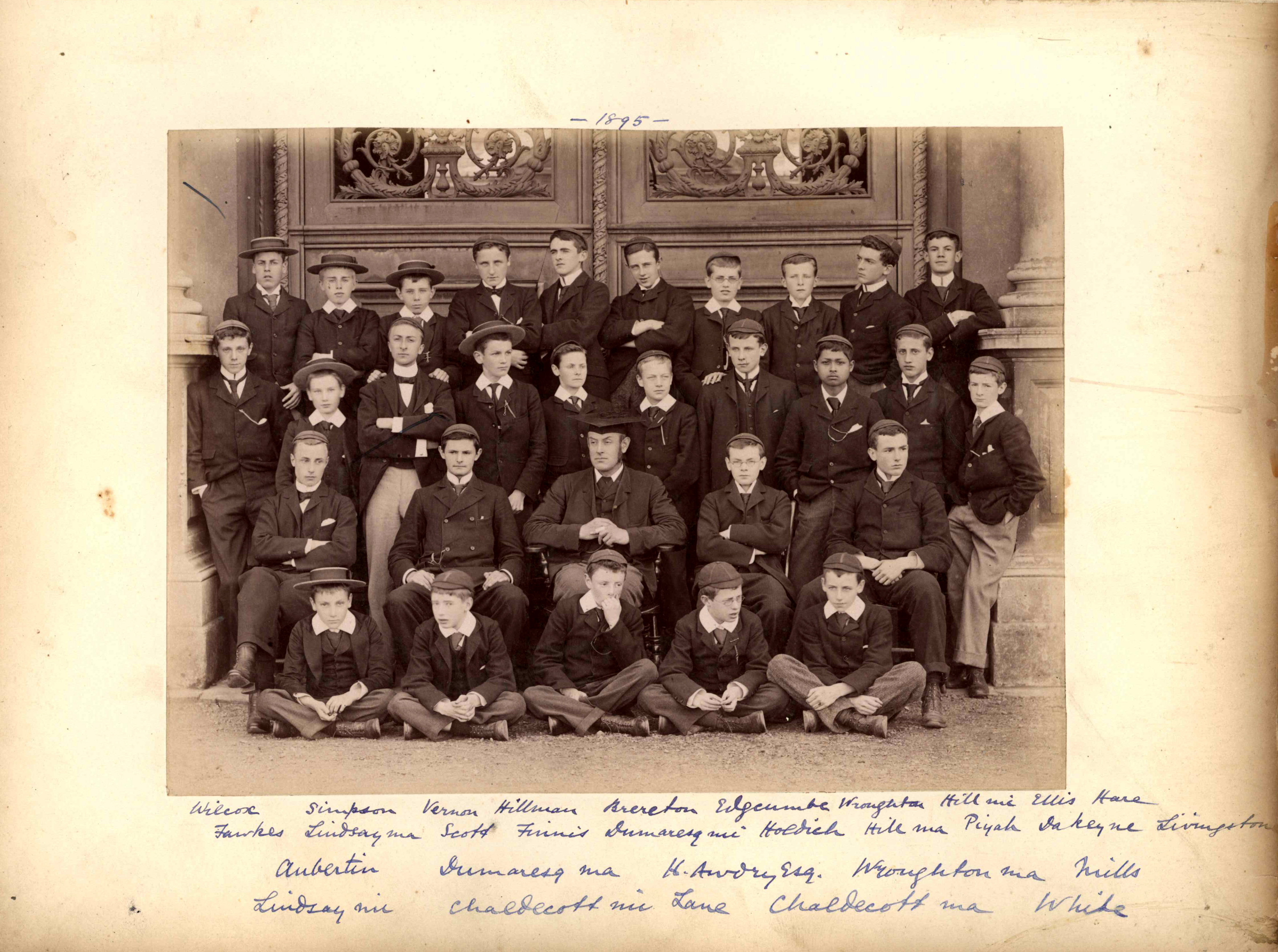
Hardinge 1895 HR Caldecott, 2nd from right, OA Chaldecott 2nd from left. Courtesy of Wellington College Archive
Harold Richards Chaldecott OBE was in the Hardinge from 1893, a year ahead of his brother Oswald Arthur Chaldecott who would also join him in the Lodge in the 1920s. They are both show in the 1895 Hardinge Dormitory photograph above, along with Frank Finnis, fourth from the left, second row from the back. A school photograph in ones early years, cross-legged on the ground seems a little unfair for two distinguished gentlemen, and we hope they will forgive this intrusion.
He went on to Glasgow University and studied to become a Naval Architect. He graduated to work for Armstrong Whitworth.
He served as a territorial gunner from 1909, rising to Captain in the Great War, and after the war worked in the shipyards in the North East as manager of the Elswick Shipbuilding Yard in Newcastle and as a naval inspector.
He was made an OBE in the 1918 Birthday Honours List.
Chaldecott was initiated into Victoria Commemoration (Reserve Forces) Lodge No 2666, now known as Reserve Forces Lodge of Northumbria Lodge, and joined the OW Lodge at the July meeting in 1922, becoming Worshipful Deputy Master in 1930. He was awarded LGR.
His son, Capt John Stickland Chaldecott, who had followed his father and uncle to Wellington and into the army, died on active service in 1941 serving with the Queen’s Royal Regiment and was described as “one of nature’s perfect gentlemen”.
Detail from above: HR Caldecott, 2nd from right, OA Chaldecott 2nd from left
Major Edward Alfred Mitchell Innes KC CBE went to Wellington, first to the Talbot and then the Blücher in 1876. He was the chief supporter of the Literary and Debating Societies in his time and become a Prefect before winning a scholarship to Balliol.
He was called to the Bar at the Middle Temple in 1894 and joined the North Eastern Circuit. He was Recorder of Middlesborough 1915-28, a Bencher of the Middle Temple from 1918, Chairman of Hertfordshire Quarter Sessions from 1924; the Recorder of Leeds from 1928, a Commissioner of Assize, Midland Circuit from 1930, Chancellor of the Diocese of Ripon from 1929 and Solicitor-General for Co.Palatine of Durham from 1930. In 1931 he became chairman of the Bar Council. He had previously served as vice-chairman of the Council for four years.
He was a committed Hertfordshire man, being Mayor and Bailiff of Hemel Hempstead , a JP and a Deputy Lieutenant for Hertfordshire. His commitment extended to his military service a territorial with the 2nd (Hertfordshire) Battalion of the Bedfords, and went on to serve in the Great War, rising to the rank of Major.
He was a member of the Travellers’.
Mitchell-Innes was another of those members of the Lodge initiated into masonry at University, in this case by Apollo University Lodge No 357 whilst he was at Balliol. He joined the lodge in June 1910, and became Worshipful Deputy Master in 1921, the year the PSLC Festival was held at Wellington. The Wellington Yearbook recalls “No one who was present in the Gymnasium on that occasion will forget dignity and charm with which he carried out his duties; if anyone could be described as silver-tongued, it was surely Mitchell-Innes”.
He was also a member of Northern Bar Lodge No 1610, Hertfordshire Regiment Lodge No 4537 and a founder of the Old Berkhamstedian Lodge No 4903. He was exalted into Inns of Court Chapter No 1610. He was made Senior Grand Deacon in 1926, and Grand Registrar by Grand Lodge in 1930.
John Hayes Simmonds CB was initiated into the Lodge at the February meeting in 1910. He would be joined in the Lodge in the October of the same year by his brother Maurice Hayes Simmonds, and both would serve the Lodge for the rest of their lives, 36 and 61 years respectively. They were scions of the Simmonds banking family that later became part of Barclays. They were both keen riders, and the Garth was probably John’s strongest passion, one he shared with Lord Dorchester.
John was in the Picton, a member of the XV and a Prefect, before going up to Magdalen College, Oxford.
His Obituary from the ‘Berkshire Chronicle’ , on Friday 6th September 1946, speaks of his life and its many and varied accomplishments:
Death of Mr. J. H. Simonds – Well-Known Reading Banker
Following a sudden illness, the death occurred in the early hours of Thursday morning of Mr. John Hayes Simonds, C. B., at his residence, Newlands, Arborfield. Mr. Simonds, who was in his 68th year, had seemed in perfect health on the previous day when he had attended the South Berks Pony Show at Calcot. He was the son of the late John Simonds.
One of the best-known figures in Reading and the county, Mr. Simonds was a director of Barclays Bank, Ltd., of H. and G. Simonds Ltd., and chairman of directors of Reading Building Society. He was a Deputy Lieutenant for the county and had been a Reading borough magistrate since 1934. In July last year he relinquished the position of chairman of the Berkshire Territorial Association, which he had held for fourteen years. He had been a member and treasurer of the Association for many years. He was also a trustee of Reading Savings Bank. Since 1929 he had been Reading Borough Treasurer.
Educated at Wellington College and Magdalen College, Oxford, Mr. Simonds took his B.A. in 1900. From Oxford he entered the Reading bank of J. and C. Simonds, which had been founded in 1813 by Charles Simonds. He subsequently became a partner in the bank, and when it was acquired by Barclays Bank, Ltd., in 1913, he became a local director of that company. Later he joined the board of directors o Barclays Bank Ltd. His association with H. and G. Simonds as director extended for some 20 years.
It was in 1900 that Mr. Simonds was commissioned into the 1st Battalion, Royal Berkshire Regiment, subsequently the 4th (T) Battalion. He retired in 1911 but later rejoined the 2/4 Battalion in 1914 as Major, and served in France. In the last war he served with the Arborfield platoon of the Home Guard.
Mr. Simonds was a man of wide interests and he held office in a number of organisations in the locality. He was treasurer of Berkshire County Cricket Club, Reading Rowing Club, Berkshire Playing Fields Association, of which he was also a member of the executive committee; Berks Miniature Rifle Association, Reading Poppy Day collections, the Y.M.C.A. War Service Fund in Berkshire, and many other bodies. Among other organisations with which been officially associated were the Wokingham Club, Reading and District Fat Stock Society and Arborfield Cricket Club. He was hon. treasurer of the local fund for the Royal Show at Reading in 1926. Mr. Simonds was actively involved with the Savings drive during the war and was chairman of the committee of Reading Warships Week and chairman of the Bonds Committee of the Salute the Soldier campaign locally.
Although interested in all sports, Mr. Simonds had closest associations with hunting. He had been a member of the Garth almost all his life, and had been treasurer since the death of his father in 1929. In his younger days he had been a useful rugby player and had appeared for Berkshire Wanderers on frequent occasions after leaving Oxford.
In 1911, Mr. Simonds married Miss Aline Rhoda Sturges, daughter of Mr. Edward Murray Sturges, of Barkham. The sympathy of their many friends will go out to Mrs. Simonds and the son and two daughters – Major J. A. H. Simonds, Mrs. Walker and Mrs. J. F. Hart.
Dudley Massey Pigott Carleton, 2nd Baron Dorchester, joined the Lodge in 1910, and was a “dashing cavalry officer” with the 9th Lancers.
Born in 1876, he went to Wellington and the Combermere in 1888.
After Sandhurst he was commissioned into the 9th Lancers and served in South Africa between 1899 and 1900, the North Nigeria Campaign between 1902 and 1903, the Kano-Sokato Expedition and throughout the Great War, especially in Salonica and the Balkans, for which he was made an OBE. He was also awarded the Order of the White Eagle 4th Class, by the King of Serbia; the Greek Medal for Military Merit 3rd Class; and the Croix de Guerre by the French President.
He succeeded to the title of 2nd Baron Dorchester, of Dorchester, co. Oxford in 1925.
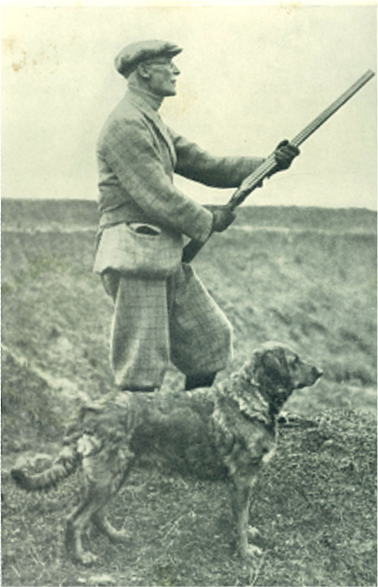
Lord Dorchester was a member of the Cavalry Club, the Royal Yacht Squadron, and was Master of the Garth, whose Treasurer was for many years Dorchester’s fellow Lodge member John Simmonds. It was under Dorchester’s Mastership that the Garth met at College in 1925, which is believed to have been a first. He put his passions to paper publishing his thoughts on a sporting life “Sport: Foxhunting and Shooting” in 1935.
Dorchester was another of the Lodge’s brethren to have been initiated into Wellesley Lodge No 1899 in Crowthorne.
Macnaughten was born in 1872 in India before going to Wellington and the Hopetoun. He was a member of the XI and a prefect. He went to Woolwich where he won the sword of honour before being commissioned into the Gunners.
He served in India from 1894 to 1896, West Africa from 1898 to 1899, South Africa from 1900 to 1902, Somaliland from 1903 to 1904, India from 1905 to 1909, before returning to England. He was Major Instructor of Gunnery at the RH & RFA School of Gunnery at Shoeburyness in the run up to the war in which he served, being made a CMG and winning the DSO, the Croix de Guerre and eight Mentions. He was ADC to the King in 1920.
He resigned his commission as a Brigadier General and went to Shanghai to work with British American Tobacco. He became Chairman of the Shanghai Municipal Council, President of the United Services Association and the St Andrew’s Society.
He died a stone’s throw from College in Wokingham in 1948.
This website uses cookies to improve your experience. We'll assume you're ok with this, but you can opt-out if you wish.AcceptRejectRead More
Privacy & Cookies Policy
Privacy Overview
This website uses cookies to improve your experience while you navigate through the website. Out of these, the cookies that are categorized as necessary are stored on your browser as they are essential for the working of basic functionalities of the website. We also use third-party cookies that help us analyze and understand how you use this website. These cookies will be stored in your browser only with your consent. You also have the option to opt-out of these cookies. But opting out of some of these cookies may affect your browsing experience.
Necessary cookies are absolutely essential for the website to function properly. This category only includes cookies that ensures basic functionalities and security features of the website. These cookies do not store any personal information.
Any cookies that may not be particularly necessary for the website to function and is used specifically to collect user personal data via analytics, ads, other embedded contents are termed as non-necessary cookies. It is mandatory to procure user consent prior to running these cookies on your website.