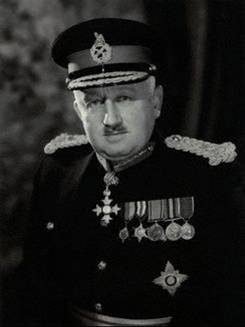
BCL Kemp. Hardinge 1939 Courtesy of Wellington College Archive
Brian Charles Lavers Kemp was a schoolmaster who was initiated into the Lodge in 1934 and served it for twenty-two years, much of that time as our Assistant Secretary at Wellington. He was the first member of Common Room to join the Lodge that was not an OW, and one of five new members of the Lodge that year, and particularly welcomed as a firm link to the teaching staff.
Kemp, BCLK as he was known to most boys, or Bertie as he was known to friends and colleagues, had been educated at Manchester Grammar School and Rossall; he had been both a scholar and cox of his Oxford college, Corpus Christi. He was a committed servant of the College. He was President of Common Room, its second senior Tutor (Hardinge 1931-41; Hill 1941-53); the Head of the Science Department (1932-53), the sponsor and compère of its cinema, the Scoutmaster of the Senior Troop, the head of Civil Defence, and the founder and conductor of the Sing-Song Society, which inspite of its amusing name hid a serious purpose, that of raising money for the Mission and the Walworth Clubs.
The 1953 Yearbook listed his many lasting and timely contributions to Wellington on his retirement:
“The most tangible expression of BCLK’s work at Wellington is the Science buildings, brought into use in 1935. Excellent in their equipment and amenities, these when new could stand comparison with those of any English secondary school; and after eighteen years they are in no danger of obsolescence, and are such as a school would be hard put to it to finance today.
Hardly less important in the School’s history was its system of air-raid shelters, built largely with boy labour in the years immediately before the second world war. B.C.L.K.’s inspiration was behind it all, and behind the later developments of fittings and comforts. It is hardly fanciful to believe that but for this system the School might have been forced into a prolonged exile as a result of withdrawal of boys, or of requisition by the authorities; with what results in the interruption of its traditions or in the spoliation of its lovely setting one can hardly guess.
These almost prophetic labours B.C.L.K. followed up by establishing a highly efficient A.R.P. system. In this work he was typically thorough and conscientious, and no respecter of persons when rebukes were earned for slackness, or for breaches of the blackout regulations; just as he could be trusted loyally to support his deputies if they incurred unpopularity in the performance of their duties.”
His other memorable passion was for speed, and anything on 3 or 4 wheels, especially his Siddeley Special called “Gargantua”.
Major Ernest Arthur Northen was in the Orange from 1911, arriving at the same time as fellow Lodge member Kenneth Latter, and became a dormitory prefect before going to the RMC Sandhurst. He was in the 2nd XV at Wellington, and the 1915 Yearbook’s notes on that team describes him, perhaps somewhat indifferently, as a “Forward. Good out of touch, but slow. Hardly makes enough use of his size and weight”. He was also suitably enough a sergeant in the Corps.
Commissioned in the 5th (Princess Charlotte of Wales’s) Dragoon Guards in 1916, he saw service in both wars, with a brief retirement to civilian life in between before being recalled to his Regiment which had become the 5th Royal Inniskilling Dragoon Guards.
He was initiated into freemasonry by the OW Lodge in 1933, becoming Worshipful Deputy Master in 1943. He joined the Lodge of Antiquity No 2 in 1948, being nominated by them to be a Grand Steward in 1958 and was that Lodge’s Master in 1959.
He was a member of both the Cavalry and Constitutional Clubs.
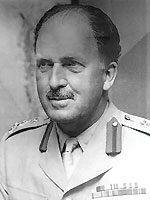
Major General Sir Leonard Henry Atkinson KBE or ‘Atco’ was in the Benson from 1924. He read engineering at UCL and was commissioned into into the Ordinance in 1936. He transferred to the REME at its formation in 1942, serving initially with the famed Guards Armoured division in Europe from 1943-1945, and was to serve the REME for the rest of his career, becoming DEME 1963, taking over the Army apprentices colleges at Arborfield and Carlisle in 1965 for the Corps, and became its Colonel Commandant in 1967 on his retirement as a Major General.
It was whilst commanding the REME component of the Guards Armoured Division as part of the liberation of Europe that he had the essential if unglamorous task of keeping military vehicles in a fit condition for Horrocks’ boys. Among many later appointments, he was an instructor at the Staff College at Quetta, Commandant of the REME training centre and Commander of Berkshire District.
On his retirement he became Chair of the Council of Engineering Institutions, and Chair of a parliamentary working party on maintenance engineering. He was an active liveryman with the Turners Company, was their master in 1987, and an exceptionally well regarded stamp collector, still referenced today; he was a Fellow of the Royal Philatelic Society of London and his stamp collection was exhibited at Alexandra Palace.
He was initiated into Connaught Army & Navy Lodge No 4323, and joined the OW Lodge in 1953, preceded by his brother Rodham, and followed some years later by his son Charles. He was Worshipful Master three times in 1960, 1970, and 1971. He was Chairman of the Masonic School for Girls, a member of and later the President of the Board of General Purposes, and he was also very senior in Rose Croix. His son Charles followed him into the Benson and into the Lodge, being initiated in 1970 and becoming Master in 1976. However he followed in his uncle Rodham‘s footsteps in terms of profession.
He was a member of Bucks and the Naval & Military Club.
Vernon Seymour Bryant was an Assistant Master at Wellington College, tutor of the Hardinge for two terms, and Head of the OTC.
Born in 1878, he went to Downing College Cambridge before becoming a schoolmaster. He was at Wellington for a dozen years from 1906 before leaving to run his own school in Maidenhead, which he re-named St Prian’s. He was a modern schoolmaster creating the Society of Applied Sciences at Wellington and generally supporting the sciences.
G B Godfrey-Faussett, Lynedoch 1927 Courtesy of Wellington College Archive
Major George Bryan Godfrey Faussett MBE was in the Lynedoch from 1922, before going up to Trinity College, Cambridge. He went to the City and joined Bowrings, before joining Lloyds. A TA Engineer, he joined the Welsh Guards in 1939 and stayed with them through to 1949. He was a member of the Turf.
He was a Godson of His Majesty King George V, and in 1919 he was appointed Page of Honour to His Majesty.
He wrote a biography of his father Sir Bryan Godfrey-Faussett, naval equerry to George VI, based on the numerous diaries kept by his father and published it under the title “Royal Servant Family Friend”.
He joined the Lodge in 1965 and was Master in 1968. He was initiated into Lutine Lodge No 3049, the Lodge of Lloyds of London. He also joined Athlumney Lodge No 3245 and its Chapter.
He received the MBE for his service in the Second World War ‘In recognition of gallant and distinguished services in North West Europe.’ The citation states:
‘This officer has been DAQMG at HQ 21 Army Group since Oct 43. Since Feb 44 he has been dealing with the provision, supply and repair of all tanks and ‘A’ vehicles in the force. Before the operation he also dealt with their waterproofing. Throughout this period he has shown outstanding ability and perseverance. He has never spared himself. The smooth and continuous flow of replacement tanks to the armies in the field has been largely due to his efforts. He is an officer of personality and tact, whose work has been untiring and the results produced thereby invaluable.”1
Brigadier Mervyn Christopher Thursby-Pelham OBE went to Wellington in 1934 and was in the Stanley, where he was a dormitory prefect, a humble apprenticeship in authority for the future Commanding Officer of the Welsh Guards. From there he went up to Merton. Almost inevitably he was christened ‘the Thirsty Pelican’ although, as several of his junior officers noted, “hardly ever in front of him…”
He joined the Lodge in 1958, and became Worshipful Master in 1965. He was an initiate of the Old Wellingtonian Lodge’s Mother Lodge, Household Brigade Lodge No 2614.
His military life is best left to those that served with him:
“Christopher Thursby-Pelham who died aged 95 on 24th April 2016 was an immensely respected and much-loved Welsh Guardsman, whose service to and love of the Regiment continued long into his retirement. He was an inspiration to young and old alike.
Christopher was born on 23rd March 1921, in London. His father, Captain Nevill Thursby-Pelham served in the Regiment in the First World War and his cousin, Walter, whose father, the Reverend A H Thursby-Pelham had been Padre to the 1st Battalion in 1917, also served in the Regiment in the Second World War.
Christopher spent much of his childhood at the family home in Carmarthenshire where he learnt to fish on the Towy, and later on the Usk where he was much involved in the Usk Valley Casting Club. He was also a highly skilled sailor and kept a house on the Isle of Wight, where he took part in many yachting events and was a member of the Royal Yacht Squadron.
After education at Wellington and Merton College, Oxford Christopher was commissioned into the Welsh Guards in March 1941 and in January 1942 he was posted to the newly formed 3rd Battalion. In March 1943 the Battalion disembarked in Tunisia as part of 1st Guards Brigade. Christopher served throughout the North African and Italian Campaigns, becoming Adjutant in 1944. This outstanding fighting Battalion ended the war in Austria and was then disbanded in 1946.
After the war Christopher remained in the Regiment attending the Staff College in 1950. Numerous Staff and Regimental postings followed before he became Regimental Adjutant in 1956. In 1961 he was appointed Commandant of the Guards Depot at Pirbright, a job he loved and where he made many friends throughout the Household Division. This was followed by a posting to the Allied Staff Headquarters in Berlin and then in 1964 he became the Regimental Lieutenant Colonel. On promotion to Brigadier he became the Chief of Staff Headquarters London District. His final job in the Army was Deputy Fortress Commander Gibraltar.
On leaving the Army in 1976, Christopher worked for the British Heart Foundation, first as Appeals Director and then later as Director General. When he joined the charity, its annual income was only about £1m. After he became the DG he co-opted another very popular Welsh Guardsman, James Malcolm, and together they built up the charity to become one of the biggest medical charities in the UK.
Christopher was immensely popular, both with the employed staff, and with the many volunteers – virtually all of whom had some direct link with heart disease. By the time he retired in 1988 the charity’s annual income was in excess of £50m and when he left he was awarded a much-deserved OBE.
However, it was his continuing involvement with the Regiment which gave him great pleasure and satisfaction in his retirement. He was always devoted to and tremendously proud of the 3rd Battalion. He was instrumental in setting up the annual dinner, which latterly became a lunch, at Boodles, but his particular work was the exceptionally popular battlefield tours to North Africa and Italy which he organised and led. These tours followed the path of the 3rd Battalion through Fondouk and Hammam Lif in Tunisia, followed by the terrible battles up Italy to Florence and then across the River Po to Austria, and they were enjoyed by many former members of the Regiment and many younger Welsh Guardsmen. His unrivalled knowledge, his inspirational leadership and his love of Italy made these tours so memorable. Christopher’s strong Christian faith opened the door to reconciliation with his former enemies and few will forget the Church Services with representatives of the German Army which were held at Monte Battaglia and other battlefields in Italy.
Christopher’s knowledge and love of Wales and Welshmen had been an underlying thread of his career in the Regiment and had been so important to him when he was Regimental Lieutenant Colonel. It gave him great pleasure to be President of the Monmouthshire Branch of the Welsh Guards Association from 1985-1998 where he was much loved and respected, and he was never happier than with his old friends.
He married Rachel Willson, whose two brothers were Grenadiers, in the Guards Chapel in January 1943 when he was aged 21, thus incurring the wrath of the Regimental Lieutenant Colonel. It was an enduring marriage and in 2000 Christopher and Ray moved to Suffolk to be close to their daughter, Philippa. Ray died in 2011 after a long illness and Christopher’s devoted care for her is an example to us all. After Ray’s death Philippa, with her husband Tim, looked after Christopher so wonderfully well in the evening of his life.
Christopher Thursby-Pelham was an exceptionally kind and thoughtful person. He is survived by his daughter Philippa and son David. His death brings to a close the history of 3rd Battalion Welsh Guards and the ever smaller number of Second World War soldiers. He was a soldier who throughout his service sought nothing for himself but simply gave his all to the Regiment, the Regimental family, his friends and his own family.” 1
The only addition to this full portrait of a fine man should be left to Philip Brutton who served with him in Italy from 1943 to the end of the war, and who wrote a fine memoir of that conflict Ensign in Italy in which he recalls Thursby-Pelham’s fishing prowess in uncertain conditions. On 18 March 1944 Thursby-Pelham went fishing with Joe Gurney, a fellow officer, using a rowing boat, some sticks of gelignite (number not specified), and half a plan to explode the latter by means of a battery and some wires from the boat. Obviously Physics lessons at Wellington had not attained their current state of elevated prowess, but Brutton notes that all the other officers had observed the conductive characteristics of electricity in water:
“the Adriatic proved no exception. Christopher created his electrical circuit. The wires touched the rudder. The Gelignite did not sink. The boat blew up. There were casualties among the fish and Christopher and Joe joined them in the drink, suffering nothing more than badly bruised backs, a small hole in their pockets to pay for the boat and a major rocket from the Commanding Officer.” 2
The story was immortalised by a cartoon drawn by Colonel Val French-Blake CO 17th/21st Lancers:
Capt Christopher Thursby Pelham WG & Capt J J Gurney WG, experimental fishing in the Adriatic. 3 By: Col V ffrench-Blake 17th/21st Lancers
The Reverend Kenneth Alfred Latter MC was in the Murray, arriving at College in 1911 on the same day as fellow Lodge member Ernest Northen, and was a College Prefect in 1916, and unsurprisingly went straight from Wellington to Woolwich, and in February 1917 was commissioned into the Gunners.
He was thrown straight into the thick of it, serving with 310 Brigade RFA.
“Major R. C. Foot has Kindly furnished [the unit war diary with] the following notes of the experiences of the 310th Brigade:
On the 27th [August] we were in action by Mametz Wood and Bazentin Wood. Here we fired a barrage for an attack on the Longueval-Guillemont area that morning. The 28th saw us in action at Ginchy covering the advance on Morval, which proved rather a difficult place to take. Here Latter behaved very gallantly under heavy shelling, for which he was subsequently awarded the MC. I had some very nice shooting from here on some infantry dragging light trench mortars; I hit two teams and counted 12 dead and all three mortars left there next day. We remained at Ginchy two days, and on the 30th went into action at Morval. From this position we covered the advance on Sailly Saillisel Ridge, which was taken on September 1st.
Headquarters went to Le Trechon on the 7th [September], the advanced infantry having on that day reached a line about 5000 yards east of Obies. D/310 came under heavy shell fire during one of its advances, and Lieuts. W. P. Holt and K. A. Latter were badly wounded.”1
His MC Citation reads:
“When ordered to reconnoitre for a gun position for an advance, he found the enemy in possession of the area, and sweeping all approaches with machine-gun fire. He successfully marked a position, although he was at times in the open within 300 yards of the hostile machine guns. Later, in command of a detached section of his battery, he displayed great gallantry and initiative, moving to and fro several times from his section to the main battery position for orders, in preference to sending runners from his men.”2
He retired from the army in 1929 due to ill health, after five years on the HP List. He took to farming in the Weald around Sevenoaks and took holy orders, and at the start of the next war was at St Augustines Preston in East Sussex.
He joined the Lodge in 1936 and became Worshipful Master in 1942, becoming only the second Worshipful Master, following the sad passing of the the Grand Master HRH the Duke of Connaught & Strathearn to the Grand Lodge above. Latter had been initiated into Knole Lodge No 1414 in Kent. He joined several lodges, including Comrades Lodge No 2976 in Essex, North Star Lodge No 3927 in London, and Agricola Lodge No 4501 in Kent.
He became a Provincial Grand Chaplain in both Kent and Somerset.
He was a member of the Rag.
War Services of the 62nd West Riding Divisional Artillery by A.T. Anderson
Eric Redwood was initiated into Apollo Lodge No 357, the Lodge of Oxford University, whilst up at Merton. He had been in the Stanley at Wellington College.
He joined the OW Lodge in 1921 and was Worshipful Deputy Master in 1928. He was awarded LGR.
He was a Barrister, and served in the RASC during the First World War, and served in France, Salonika and Palestine.
He went on to have a broad and varied masonic career, also founding Rosemary Lodge No 2851 (now the lodge associated with the special forces), America Lodge No 3368, and joining Jubilee Masters Lodge No 2712. He also joined Euclid Chapter at Cambridge. He was appointed Assistant Grand Director of Ceremonies in 1927.
Van Duzer went into business in London, but served as a Territorial Officer in the Great War with the 4th (Hallamshire) Battalion of the York & Lancaster Regt, rising to the rank of Captain.
He was the son of Fredrick Van Duzer from Newburgh NY, who was a significant figure in Anglo-American Masonry and Founder of AMULL. The history of American Lodge tells of Frederick Van Duzer as:
“the first American to wear a collar of Grand Office in England. He was a founder of five lodges, three Royal arch chapters, two lodges of Mark Master Masons, two Preceptories of Knights Templar, a Chapter of Rose Croix, (ancient and accepted rite), and a Chapter of Improvement.
He was also a member of the Grand Lodge National pour La France and a founder of a Lodge under that Grand jurisdiction; a member of the Arc Mariners, Red Cross of Constantine, of the Allied degrees, Royal and select Masters, Royal order of Scotland, and of the Society of Rosicrucian’s in England. He was an honorary member of nine lodges, four lodges of Mark Master Masons and three Preceptories.
It should also be added that he was the representative at the Grand Lodge of England of four American Grand Lodges, and representative from seven Grand Councils of Royal and Select Masters in America to that of England. He was a patron of the Royal Masonic Institution for Girls, and that for the Boys, the Benevolent Institution and of the Mark Benevolent Fund. In November 1929 it became known that the highest degree in the Ancient and Accepted Rite, that of Grand Inspector General 33°, had been conferred upon W Bro Frederick C Van Duzer. He was the first American to attain that distinction in England.”
The Minutes record that he was a frequent visitor to the OW Lodge in its early years.
F A Finnis. Hardinge 1897 Courtesy of Wellington College Archive
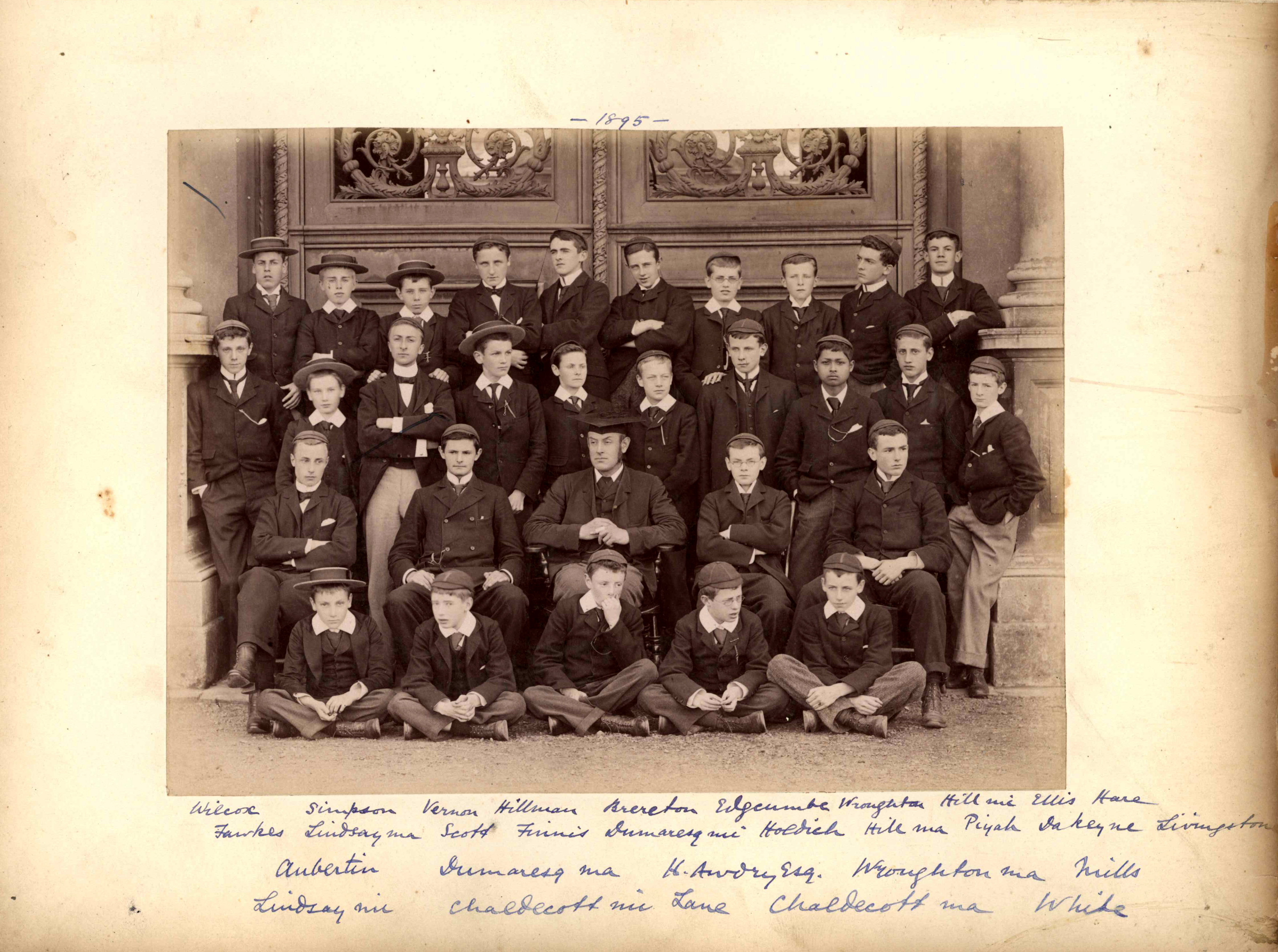
Colonel Frank Alexander Finnis CB OBE was born in 1881 in Murree, India, the eldest son of Colonel Henry Finnis CSI CBE Royal Engineers. He went to Wellington in 1894, and was in the Hardinge, where his brother Steriker William Finnis would follow him five years later, and another brother and a nephew would follow them. The Chaldecott Brothers were in the Hardinge with him, and they are all shown in the Dormitory Photograph of 1895. Frank was made a Prefect. He would go on to Woolwich and win the Sword of Honour, and be commissioned in the Gunners.
Things were reversed in the OW Lodge, with his brother Steriker joining the Lodge in 1911, whilst Frank joined the Lodge in 1935. Frank was made WDM shortly thereafter in 1937. He was initiated into Stewart Lodge No 1960. He was also a joining member of Kitchener Lodge, and was made a Grand Deacon by Grand Lodge.
He served from 1900 to 1901 with No. 31 Company, Western Division, RGA at Plymouth and was promoted Lieutenant RGA on 3 April 1901. He served in South Africa from November 1901 to October 1902 with No. 56 Company, RGA and his four clasp QSA is confirmed in the army lists for his service in the Orange River Colony and on the medal roll for services also with 22 SD, 63 Co. RGA. In October 1902 he was back in India and until 1906 he served with No. 8 Mountain Battery, RGA at Rawal Pindi, Punjab. He joined the Indian Ordnance Department in 1906 being present with the Bazar Valley Frontier Force on the North West Frontier in 1908.
In 1911 he married Hazel, daughter of Major General Leonard William Christopher CB and the following year he was promoted to Captain IOD. He was promoted to Major IOD in 1915 and was Acting Lieutenant Colonel and Assistant Director, Ordnance Services from 1917 to 1919. He received his brevet of Lieutenant Colonel in 1919 and for his services in the Great War he was MID on at least one occasion and granted the Brevet rank of Lieutenant Colonel.
He was Assistant Director, Ordnance Services, India, served in the campaign in Afghanistan of 1919 and was MID for his services. He participated in the Waziristan campaign as part of the “Waziristan Force” from 1919 to 1920 as Assistant Director, Ordnance Services, India. One presumes that since he held this position before and after the Afghan war of 1919 he served in this capacity during both campaigns. He was awarded the OBE as Major and Brevet Lieutenant Colonel Royal Artillery “for valuable services rendered in the Field with the Waziristan Force”.
He was made full Colonel in 1928, and a Companion on the Most Honourable Order of the Bath in 1930 as “Colonel OBE, Indian Army, Deputy Director of Ordnance Services, Master-General of the Ordnance Branch, Headquarters, India”. The following year he was Deputy Director of Ordnance Services, Northern Command, India, until 1933 where he became Inspector, Indian Ordnance Services, until 1935. This was his last appointment as he retired in 1935.1
On retirement from the army he moved to Camberley and became a Commissioner for Land Tax for the County of Surrey.
This website uses cookies to improve your experience. We'll assume you're ok with this, but you can opt-out if you wish.AcceptRejectRead More
Privacy & Cookies Policy
Privacy Overview
This website uses cookies to improve your experience while you navigate through the website. Out of these, the cookies that are categorized as necessary are stored on your browser as they are essential for the working of basic functionalities of the website. We also use third-party cookies that help us analyze and understand how you use this website. These cookies will be stored in your browser only with your consent. You also have the option to opt-out of these cookies. But opting out of some of these cookies may affect your browsing experience.
Necessary cookies are absolutely essential for the website to function properly. This category only includes cookies that ensures basic functionalities and security features of the website. These cookies do not store any personal information.
Any cookies that may not be particularly necessary for the website to function and is used specifically to collect user personal data via analytics, ads, other embedded contents are termed as non-necessary cookies. It is mandatory to procure user consent prior to running these cookies on your website.