H B Shiffner Bt

The Shiffners are a distinguished family. Their renown stretches back to the day a distant forebear rescued Charles II by boat after the Battle of Worcester in 1651.

Sir Henry Burrows Schiffner Bt OBE was born in Lewes in 1902 and joined his brother Sir John, the 6th Baronet, at the Benson in 1916, and would go on to be Head of House. It was his brother’s last year and he would go to Sandhurst in 1917, and on to join the Royal Sussex. Sir Henry acceded to baronetcy on his brother’s death in action with his regiment on 24 September 1918.

Sir Henry was commissioned into the Royal Artillery, and played in the RMA XV alongside fellow lodge member Henry Inglis’s son, George, who was also bound for the gunners. He served as ADC to the Governor of Uganda, Sir William Gowers from 1926-29, and married Elizabeth Gowers, the Governor’s niece and daughter of Sir Ernest Gowers in 1929.

He was initiated in to the Lodge in 1924, aged 22.

He was hit and mortally wounded on 22 November 1941 whilst on forward reconnaissance soon after taking over the 203 Field Battery of 51st (The Westmorland and Cumberland Yeomanry) Regt RA in the desert at Sidi Rezegh, in what is now Libya.[1]

He was 39. He is remembered on the Alamein Memorial in Egypt, and in the family church.

[1] “Our Parish” by Jack Harmer

H J Brougham

Henry J Brougham was born in 1888 at Wellington College and joined the Stanley in 1901, becoming Head of School in 1907. Described as “one of the great sportsmen of the period immediately before the Great War” he excelled on the cricket pitch, the rugby field and on the rackets court.

At Wellington he was in the XI for three seasons, captaining the side in 1907. The same year he won the Public Schools Championship Rackets. The following year he played rackets for England in the 1908 Olympics, winning a bronze. He went up to Oxford, where he won a Blue for cricket in 1911, scoring 84 in a “free and attractive innings” in the Varsity match. At county level he played for Berkshire from 1905 whilst still at Wellington right up to 1914, scoring centuries against Carmarthen, Devon, and Buckinghamshire in the minor counties and represented the Minor Counties against South Africa in 1912.

The same year he was capped four times on the wing for the England XV against Wales, Ireland, Scotland, and France. He also played for Harlequins. Interestingly he never made the Wellington XV, nor did he get a Rugby Blue.

When war broke out he joined the gunners, and fought through to 1917 rising to the rank of Major when he was invalided out as a result of being terribly gassed. His health never recovered, the gas particularly affected his breathing, a cruel blow for such a distinguished athlete. He died from the affects of gas in 1923.[1]

In addition to his many achievements, he was initiated into the Lodge in Khaki Dress at the start of the Great War, an extremely rare event, even in times of war.


[1] Wisden Cricketers’ Almanack (all references)


E F Kelaart

E F Kelaart (Blucher 1876)
Courtesy of Wellington College Archive

Major Edward Frederick Kelaart was a stockbroker by profession and a territorial gunner officer who was called to the colours during the war. He was the son of the noted Ceylonese-born physicist and naturalist of the same name.

He was in the Blucher between 1872 and 1877, and a keen and active member of the Lodge.

He was 57 when he died on active service in June 1919.

C D H Corbett

Courtesy of Wellington College Archive

Lt Col Dr Cyril Dudley Hely Corbett was a Bensonian who arrived at Wellington in 1896.

He became a school prefect before going up to University College Oxford and then to St Thomas’s Hospital, qualifying as a doctor. During his time at St Thomas’s Hospital he was initiated into Cheselden Lodge No 2870, the lodge associated with the hospital, and in time became a founder of the OW Lodge.

He served in the RAMC and was sent to France in 1916 to take command of a brigade of the Royal flying Corps, an extremely unusual appointment for an RAMC officer. After nine months he reverted to medical duties, being appointed to a base hospital for the treatment of pilots. This formed one of his major professional interests and in 1918 he  published “A study of the reaction of pilots and observers to diminished oxygen pressure.”

He died suddenly from influenza whilst in charge of the hospital in 1918. He was 37. His remained are interred at Golders Green Crematorium.

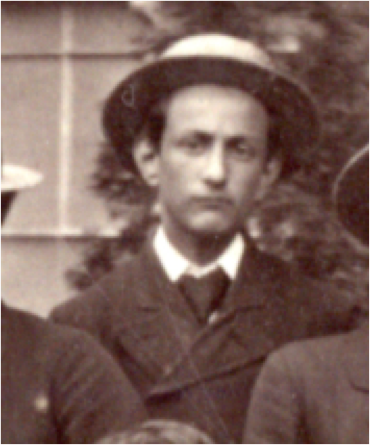
T R Stoney


T R Stoney (with H H Stoney foreground) 1899 Murray House Photograph. Courtesy of wellington College Archive

In the Murray from 1894, Thomas Ramsay Stoney captained the XV in 1900 and was the deputy head of college in 1901. He was the second of three brothers at Wellington, and went to Pembroke College, Cambridge, where he played for the College and Cambridge XIs and was sufficiently good to warrant an entry in Wisden’s ‘Lives of Cricket’s Fallen 1914-1918’. He was initiated into freemasonry by the Isaac Newton University Lodge No 859, the lodge of the University of Cambridge. Isaac Newton was a popular lodge among OWs with Bryant, Van Duzer, Larmour, Raphael, Stephenson, and Coles all being members. He joined the OW Lodge as a Founding Officer along with his brother Patrick.

He became a schoolmaster, and later headmaster of Wootton Court prep school in Canterbury.

With the outbreak of the war Stoney joined the family regiment, the Kings Own Scots Borderers.

Posted first to the 3rd Battalion KOSB, he was later attached to the 6th Battalion. He was killed in action on 10 April 1918 at the Battle of the Lys. This was the German ‘Spring Offensive’, their last push and circumstances were sufficiently grave to cause Earl Haig to issue his famous order that his men must carry on fighting “With Our Backs to the Wall and believing in the Justice of our Cause“.

He is buried at La Clytte Cemetery. He was 35. He is also remembered in his hometown of Chudleigh in Devon on the War Memorial.

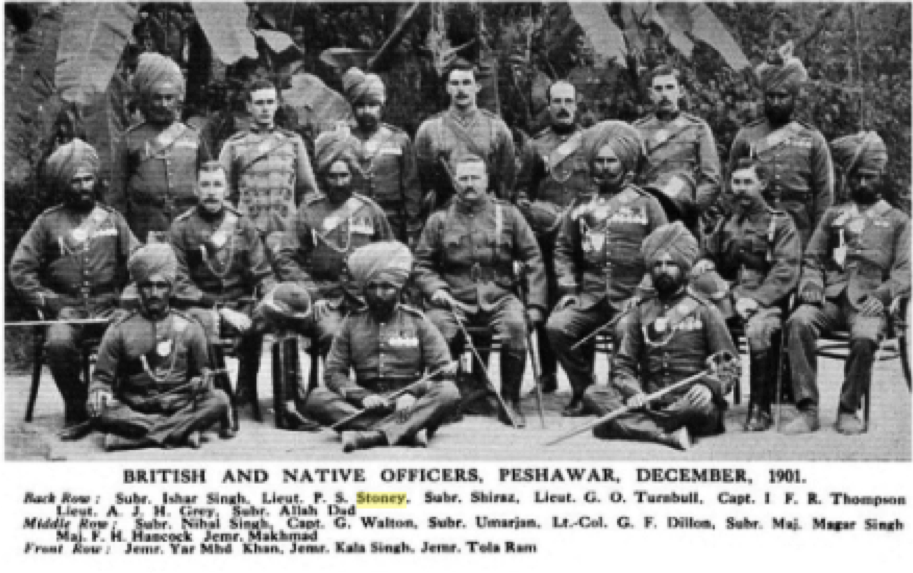
Four of the five Stoney boys joined the Army. Thomas and his brother George joined the family regiment. Both were killed; Lt Col George Butler Stoney at Gallipoli in 1916, two years before Thomas. Patrick served with the 26th Punjabis in India and was a fellow Founder of the Lodge, and the youngest Henry Howard Stoney, also a Wellingtonian (and seen in his first year at College at his brother’s feet above), served in the Staffords. Bowes the remaining son went to Fettes and on to the Ceylon Civil Service, via Pembroke, Cambridge. He died in 1910 aged 32.

The Stoney Family plaque in St Mathew’s Church, Netley Marsh in Hampshire records the devoted service and sacrifice of the Stoney family:  Thomas’s father Maj George Ormonde KOSB, Thomas and his brothers George, Bowes, and H Howard Stoney, together with Thomas’s mother and two sisters.

Baron Abinger

Lord Abinger

Shelley Leopold Laurence Scarlett, 5th Baron Abinger, joined the Anglesey in 1885.

A Naval Reserve Officer he was attached to the Bedfordshires during the war, and died on active service in May 1917, aged 45. He is buried at Brookwood Cemetery.

Abinger was Honorary Attaché to Stockholm between 1897 and 1899, an honorary Major in the Army, and a JP. He was the great grandson of Percy Bysshe Shelley (by adoption). The 1917 Yearbook spoke of his “genial bonhomie”.

As a Shelley, he was related to fellow OW and Freemason Lt Cecil W C Shelley.

Abinger was initiated into Powney Lodge No 3099 in 1906 in somewhat unorthodox conditions – he was initiated passed and raised quickly so that he might rush off and found another lodge. He was a more regular member of Malmesbury Lodge No 3156, a lodge he shared with fellow OW Capt Charles Maud

A N Blair

A N Blair

Alexander  Neville Blair was born in 1879 in London. He went to Wellington in 1893 along with three other fellow Lodge members, Simmonds, Boughey and Chaldecott. He was in the Hill. After leaving he became a brewery manager first at the West Malling Brewery and then at Lacons’ Brewery, Great Yarmouth.

Blair had been one of the original founders of the Lodge in 1909, having been initiated into Bowyer Lodge No 1036. He was exalted into Bowyer Chapter, and was also appointed a Provincial Grand Steward in Oxfordshire.

Blair was an active territorial officer; a Captain with the Paddington Rifle Volunteers, Adjutant of the Yarmouth Volunteers OTC, and he also drilled a company of the Church Lads’ Brigade.

He was gazetted to the Black Watch (The Royal Highlanders) as a 2nd Lieutenant in May 1916, and immediately volunteered for service in Mesopotamia. He left for India the following year to serve on the Staff of Northern Command. Before leaving for his posting in India, he wrote ‘the usual letters’ to be opened in the event of his death. His six-year old son Neville received the heart-breaking letter from his father reminding him that the young Neville was now charged with the care of his Mother. It also offered him some guidance for the future:

Source: The Black Watch: Fighting in the Frontline 1899-2006

He died in Colaba War Hospital Bombay on 13 March 1917 from cerebro-meningitis contracted while on active service, and is buried in Scuree Cemetery. The charge laid upon his son clearly left its mark. Colonel Harold Neville Blair went on to command the Black Watch in 1947, having gone to Wellington in 1923. He was also in his father’s house.

Blair is remembered at the Kirkee Memorial in Pune, India, together with more than 1,800 servicemen who died in India during the First World War, who were buried in civil and cantonment cemeteries in India and Pakistan but whose graves could no longer be properly maintained.


H W Crippin

Major Harry Crippin MC

Harry William Crippin MC was born near Liverpool in 1889 and went to Wellington in 1902. He was in Toyes’ House, which later became the Talbot in 1914 and was a rugby cap. He went on to RMA Woolwich where he also got his Rugby Colours, and won the foils for Woolwich at the Military Tournament before being commissioned into the Royal Artillery.

He formed part of the British Expeditionary Force sent to France in 1914 as a Lieutenant and was appointed Gunner Adjutant in 1915, before being given command of a Field Battery. Crippin was mentioned in Despatches[1] and was awarded the Military Cross in February 1915 by Sir John French for gallant and distinguished service in the field. Appointed Brigade Major in 1916 he was killed in action on 8 September whilst reconnoitring new gun positions with his General.

He was 27.

He is buried at the Citadel New Military Cemetery, Fricourt.

Eighty-three OW Gunners gave their lives in the Great War, including three members of the Lodge.


[1] London Gazette 17 Feb. 1915


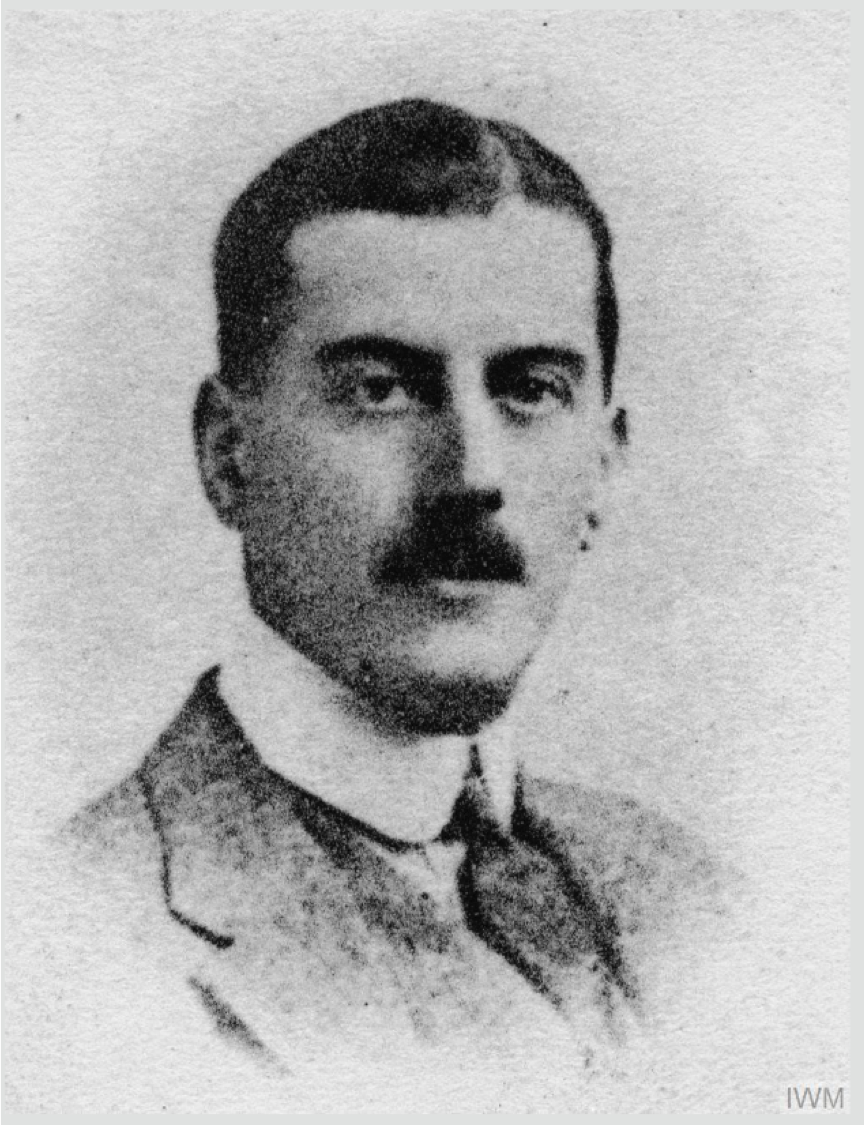
A V Stanfield

Image result for "Alfred Vivian Stanfield"

© IWM (HU 126852)

Alfred Vivian Stanfield was in the Benson from 1898, a prefect, head of House and member of the XI. He went up to Clare College Cambridge, at the same time as Siegfried Sassoon, where he won the cup for most promising undergraduate. He went to France to learn the language. He spent some time at Liancourt, a French School on English Public School lines, where he was so successful in dealing with boys that he was offered a partnership. However, he returned to England, and after a short time at Horris Hill, was given an assistant mastership at Wellington in 1911.

The 1916 Yearbook say that “He immediately threw himself into the work. He was an excellent Form Master, worked hard as Deputy Tutor in his old House, was Secretary of the Mission, and co-Secretary of the O.W. Society, and did much to improve the Cricket, interesting himself particularly by organizing nets and games for the younger boys. Later in the same year he became Tutor of the Orange. Here, too, he was eminently successful. Absolutely unselfish and absolutely fair (for he never allowed any private feelings that he might have to interfere with the interest he took in a boy), he produced excellent results. He was broad-minded and took long views, and keen as he always was on the success of the Dormitory, which was great, he always encouraged them to put the School first, and to support all School institutions.”

He was initiated into the Lodge in 1912.

In December 1914 Stanfield and three other OWs were commissioned as territorial officers on the unattached list on the strength of their service with the Wellington OTC,[1]  but “with his usual thoroughness did not propose to do so until he had made himself a thoroughly efficient officer, spending his holidays in training with other corps and taking courses. In April he was gazetted to the Queen’s, and went out with a draft in July. In France, to meet immediate needs, he was attached to the Royal Fusiliers, and was with them at the time of his death”. He was shot through the head while getting out of a trench to lead his men in an attack at Guillemont on August 26th.

It was Stanfield’s posthumous bequest to Wellington that was used to relay the floor of Old Hall with the current floorboards as the room was transformed from the former dinning hall into its current form, becaming at the same time a memorial to the fallen.

The 1916 Wellington Yearbook quoted the following passage from an unnamed friend:

It is hard to speak of a character so strong, so lovable, so full of life, and yet so absolutely simple. But it was in this that lay the secret of his influence. Absolutely upright, with the highest ideals of life and duty, he was of all men the most entirely free from the least trace of self-consciousness or affectation. His cheerful, sunny nature, his enthusiasm, his humour, his unselfishness, his ready sympathy made him the friend, and more than the friend, of every one with whom he had to do, whether boys, colleagues, or servants of the School Staff. ‘ I have lost in him,’ writes a soldier colleague, ‘ not only a friend but an ideal.’ No one indeed in our generation has been more universally or more deservedly loved.”

Sixty-four OWs are known to have died in the battle of the Somme.

[1] The London Gazette, 22 December 1914 1094G

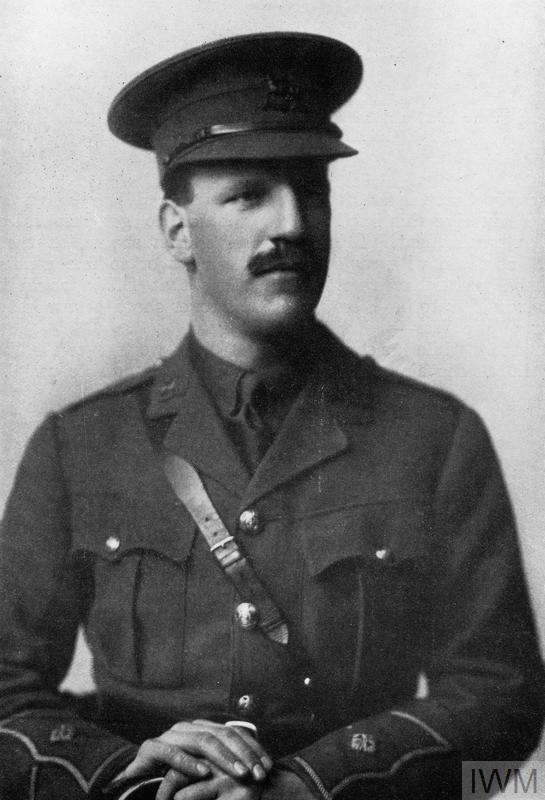
R F I Currie

Copyright: IWM

Richard Frederick Ince Currie stands out as one only five members of the Lodge who enlisted in the Army rather than be commissioned, and one of only two of those who were not later commissioned.

Currie went to Wellington in 1896 and was in Bevir’s House, now the Benson. He, like Stephenson, went up to Trinity, Cambridge, before becoming a wine merchant for a brief spell and then a tea planter in Ceylon.

He was a founder of the Lodge in 1909, and had been initiated into Rosemary Lodge No 2851, the lodge associated with the Artists Rifles and today the special forces.

During his time as a tea planter in Ceylon he joined Nuwara Eliya Lodge No 2991, a local English lodge warranted a few years before the OW Lodge in 1903. Nuwara Eliya is named after its hill station home in the heart of Sri Lankan tea country. The lodge still exists, one of ten English Constitution lodges in Sri Lanka and still meets at the Hill Club.

Currie served in the 10th Royal Fusiliers, a territorial battalion raised in 1914 and nicknamed the Stockbrokers.

He died at the battle of the Somme on 15th July 1916, and lies in Pozieres British Cemetery, Ovillers-La Boisselle.

He was 36.