Members’ Jewels

Members’ Jewels under the English Constitution*

A number of lodges have unique members’ jewels that can be worn by suitably qualified brethren. These are broadly divided into four categories: Royal Jewels, Grand Master’s Jewels, Special Medals and Special Jewels.

Royal Jewels

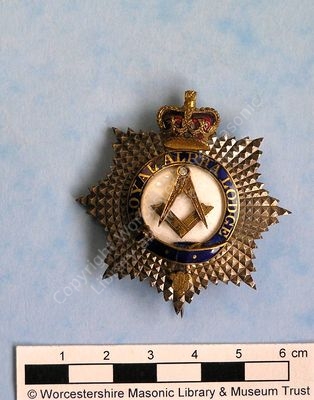
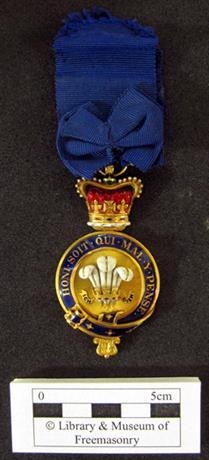
Three lodges have ‘Royal Jewels‘ or medals[1], so named in honour of those that bestowed them upon their lodges: The Lodge of Antiquity No 2, Royal Alpha Lodge No 16, and the Prince of Wales’s Lodge No 259.
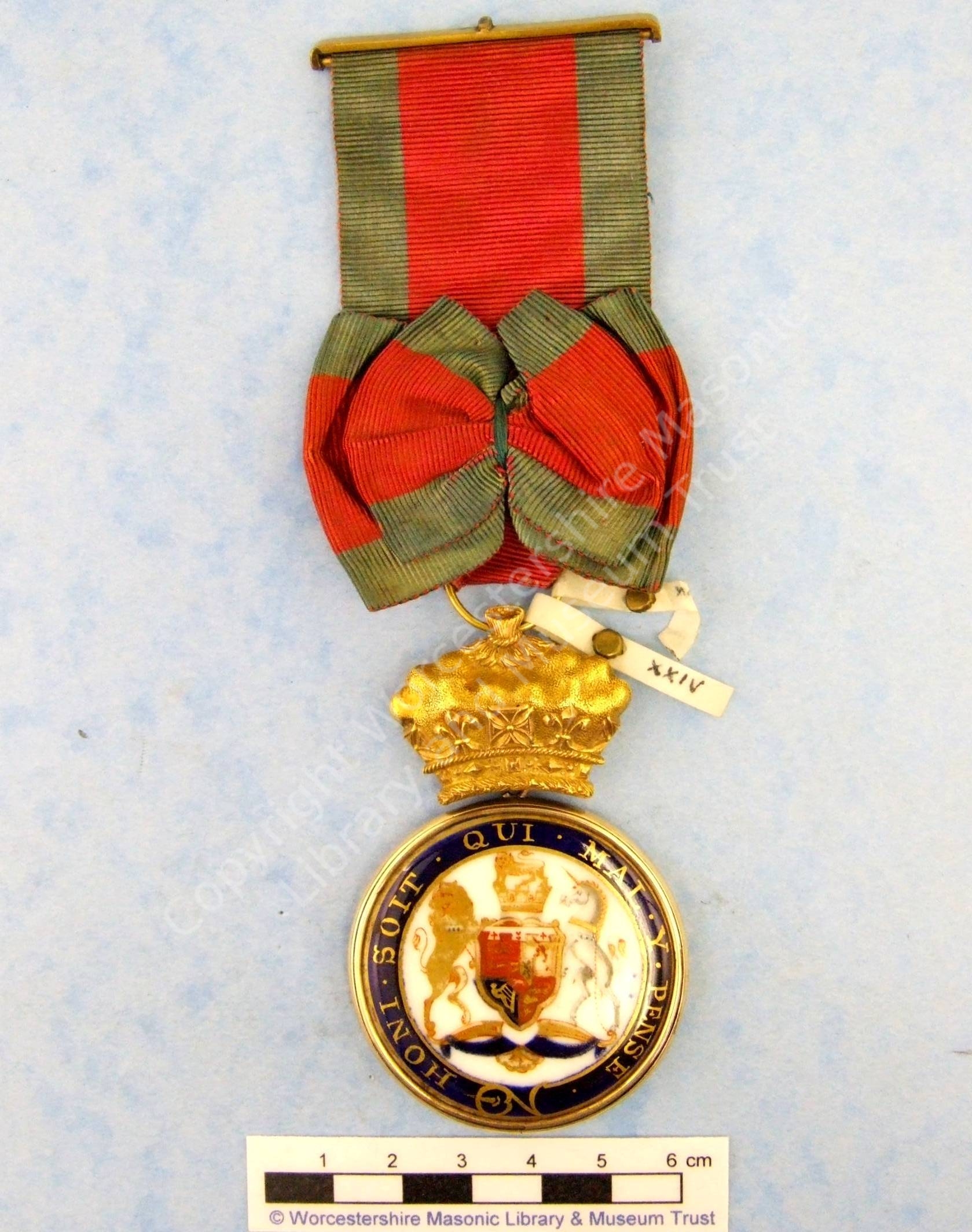


The Lodge of Antiquity No 2 Royal Alpha Lodge No 16 the Prince of Wales’s Lodge No 259

Antiquity’s jewel was the gift of the Duke of Sussex, the first Royal Grand Master. 259’s jewel descends from the Prince Regent, later George IV, whose lodge it was. Royal Alpha’s jewel is distinguished by being a collar jewel rather than a breast jewel, as in normally appended to upper part of the front of the collar where is meets in a ‘V’ as can be seen here.

~

Grand Masters Jewels

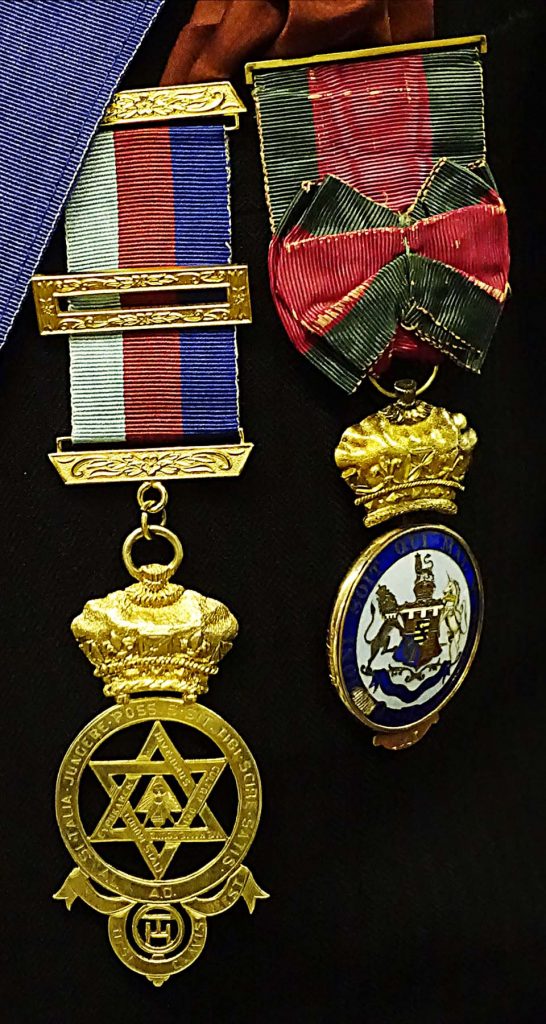
The second category comprises those bestowed by various Grand Masters over the years. A Grand Master’s Jewel is typically awarded to those lodges closely associated with men that have been or become Grand Master. The OW Lodge’s Connaught Jewel (right) is believed to be one of only six, four of which commemorate the Grand Master HRH Duke of Connaught & Strathearn:

Aldershot Army & Navy Lodge No 1971 has a jewel granted by the Duke of Connaught to mark his 44 years as Perpetual Worshipful Master.

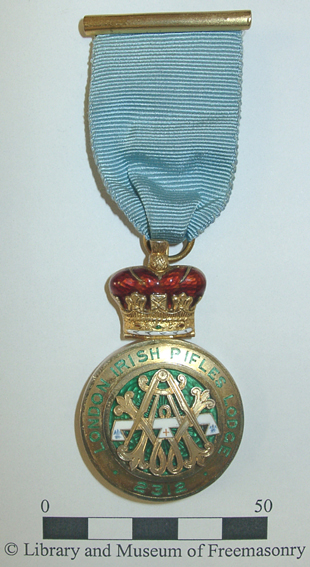
The Irish Rifles Lodge No 2312 has a Master Mason’s jewel to commemorate the Duke of Connaught’s role as the founding WM, an office he would hold for 53 years.

Unlike the OW Lodge only Master Masons are permitted to wear these jewels, but like the OW Connaught Jewel they may wear it at any and all Masonic occasions.

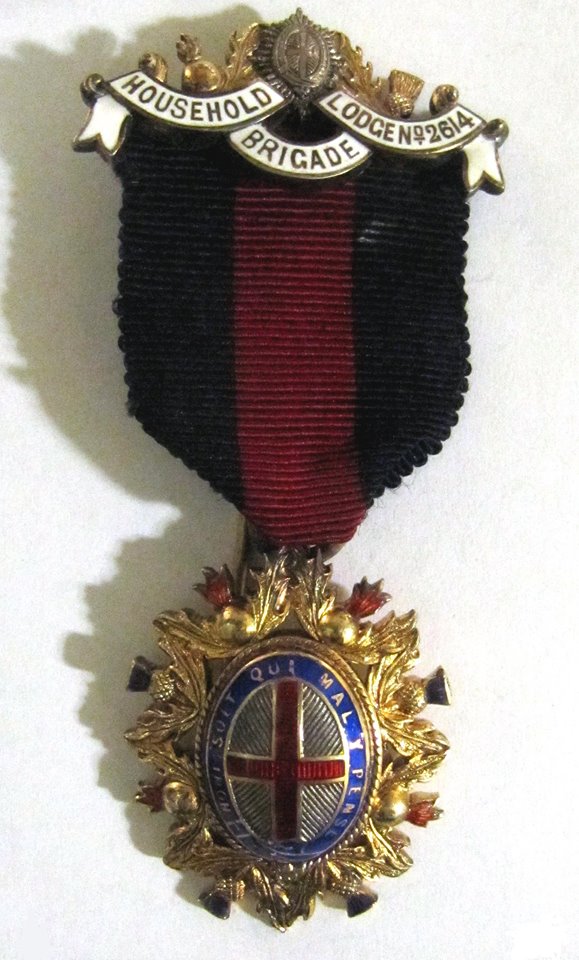
This honour is shared by the brethren of our Mother Lodge, Household Brigade Lodge No 2614, who have a members jewel, also from the Duke of Connaught who was their permanent Master, and who are similarly entitled to wear it on all masonic occasions.
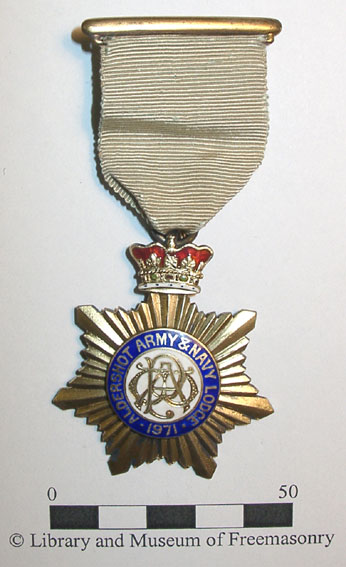
Aldershot Army & Navy Lodge No 1971 Irish Rifles Lodge No 2312 Household Brigade Lodge No 2614 Old Wellingtonian Lodge No 3404

~

Special Jewels (that are Royal or Grand Master’s but not called that!)

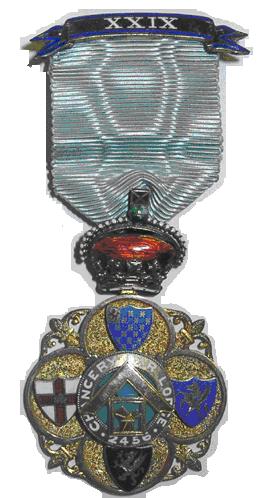
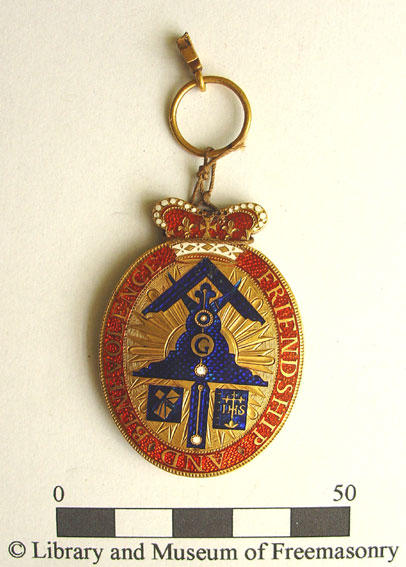
Mention here should be made of the jewel worn by members of the OW Lodge’s illustrious grandmother lodge, Jerusalem Lodge No 197. The Prince of Wales (later Edward VII) granted that lodge a ‘distinctive’ jewel, also to be worn on all Masonic occasions, in 1871 when he visited the lodge. This could therefore be both a Royal and Grand Master’s jewel, but by his own request is known as a ‘distinctive’ jewel and who are we to argue. His Royal Highness made a similar arrangement for Chancery Bar Lodge, whose jewel combines the arms of the four Inns of Court. It is referred to as a Special Jewel on his instruction so probably should be included below.
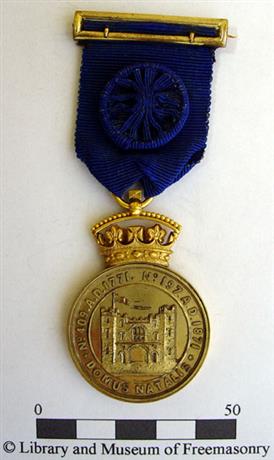
Jerusalem Lodge No 197 Chancery Bar Lodge

Lambton Lodge No 375 has a Special Members’ Jewel bestowed by Augustus Frederick, the Duke of Sussex who visited Durham in 1822. He was both a member of the Royal Family and Grand Master. It is sometimes called the Sussex Medal and can be seen in some of the photographs on the Province of Durham’s website.

The Duke of Sussex was the first Royal Grand Master and bestowed jewels on No 2, No IV and No 375; the first is denoted  a ‘Royal’ and the second ‘Special’.

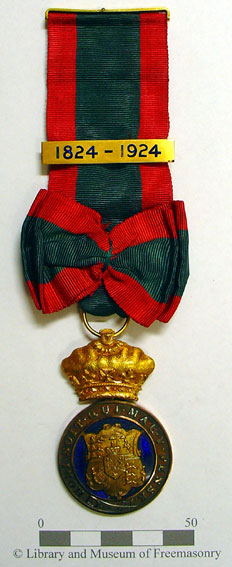
Royal Somerset House & Inverness Lodge No IV‘s Special Medal1 from the Duke of Sussex was granted in 1858 and bears the arms of Scotland with a reference to the King’s son. This is surmounted by the Coronet of a Prince of the Blood Royal borne by the Duke of Sussex. On the reverse side the inscription appears, “Immemorial Constitution. United with the Old Horn Lodge, No. 2, January 10, 1774.” On the rim the following is engraved: “Royal Inverness Lodge, No. 648. The First Lodge consecrated under the United Grand Lodge by Right Worshipful His Royal Highness the Duke of Sussex, 1814”.
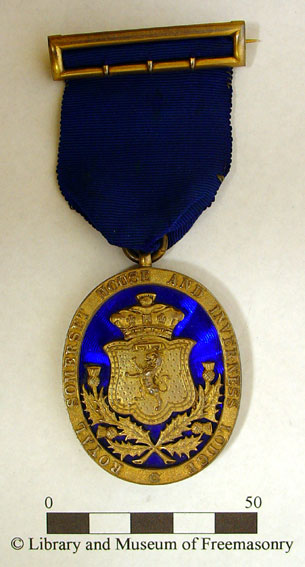
Royal Somerset House & Inverness Lodge No IV Lambton Lodge No 375

Grand Master’s Lodge No 1 have their own unique members jewels as well, denoted as a Special Medal1.
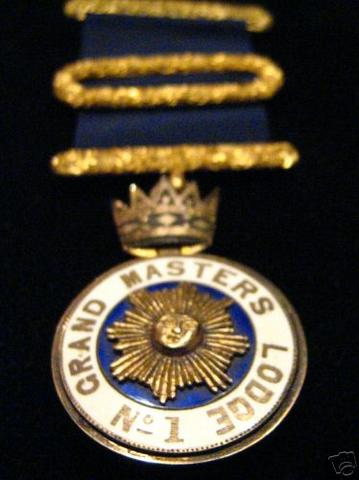
Grand Masters Lodge No 1

~

Special Lodge Jewels

The last, and largest category members’ jewels are Special Lodge Jewels that were not bestowed prefixally by members of the Royal Family or Grand Masters.

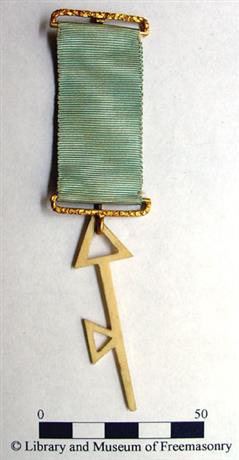
These belong predominantly to lodges with a strong founding link to an institution or another country, which is often the creative source for the design. With the fouled anchor that forms the centrepiece its jewel, Navy Lodge No 2613 is a good example of the former, whilst Der Pilger Lodge No 238 (Pilgrim Lodge) offers an excellent example of the latter, having a jewel design common among German lodges but not seen in the UK, entirely appropriate for the only English Lodge to work in German.
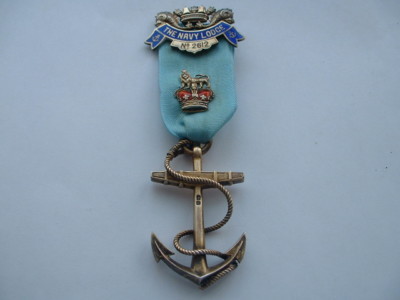
Navy Lodge No 2613 Der Pilger Lodge No 238

There are a small number of older (typically 18th century) lodges that have special pattern centenary (and bi-centenary) jewels that date from before the standardisation of the current pattern, and whilst they are not technically members’ jewels, they in effect serve both as centenary and members’ jewels.

The total number of lodges with members’ jewels is not thought to exceed 70, whilst approximately 50 lodges are thought to have special pattern centenary jewels.

There are of course a great many wonderful founders, past masters, charity and other jewels in masonry.

~

A good but imperfect guide is that many of the jewels shown above have a coronet or crown associated with the heraldic status of the benefactor. A jewel with such a detail is likely to be interesting.

~

For more information try:

The Library and Museum of Freemasonry

Lanes Masonic Records

Masonic Medals

Jewels of the Craft

Irish Masonic Jewels

There is also a piece on the Chapter of Felicity No 58 website about interesting RA Members’ Jewels that aficionados may appreciate.

*E&OE: the contents of this page are the subject of ongoing research. Please do not hesitate to contact the webmaster if there is an error or ommission.

[1] According to Lanes Masonic Records. GM No 1 and RSH&I No IV are classed as Special Medals, rather than Royal Medals.

History

1909 – Consecration

In 1909 forty-nine Old Wellingtonians who were also Freemasons forwarded a petition to the United Grand Lodge of England (UGLE) that they be granted a warrant for a new lodge, to be called the “Heroum Filii Lodge”. The petition was sponsored by the Household Brigade Lodge No 2614. UGLE having granted the petition the Lodge, numbered 3404 in the Register of the Grand Lodge of England, was consecrated at Freemasons’ Hall in London on Friday 26 November 1909 in the presence of a very distinguished company.

The Consecrating Officer was the Pro Grand Master, the Most Worshipful Brother the Right Honourable the Lord Ampthill. The Pro Grand Master was assisted by Right Worshipful Brothers the Right Honourable Lord Athlumney PGW as Senior Warden and Sir G Wyatt Truscott Bt JGW as Junior Warden. The Reverend H W Turner PGC acted as Chaplain, Frank Richardson GDC as DC, J S Granville Grenfell DGDC as ADC, and F W Pixley PGD as Inner Guard. Viscount Doneraile and Sir Edward Letchworth were also in attendance. These distiguished brethren graciously accepted honorary membership of the Lodge.

At the Consecration, in addition to the traditional appointment of the Founding OfficersCol R W Dalgety was installed as Worshipful Deputy Master, normal practice when either the Grand Master or a Prince of the Royal Blood was the ruling Master of a private lodge. Both these applied as the Grand Master, the Grand Master HRH The Duke of Connaught & Strathearn KG had graciously accepted the office of Worshipful Master.

1910 – Public School Committee

At the next meeting of the lodge in January 1910, Field Marshal Lord Roberts KG VC was elected as an honorary member, as were the Worshipful Masters, Wardens & Secretaries of the Old Westminsters, Charterhouse Deo Dante Dedi and the old Cheltonian Lodges. A month later the Lodge was invited to send a representative to the Public School Committee (now Public Schools Lodges’ Council or PSLC) and the Lodge has remained a member to this day.

1912 – “Heroum Filii” to “Old Wellingtonian Lodge”

HH Prince Maurice of Battenburg, aged just 20, was initiated by special dispensation in 1912 but sadly he was to die of wounds received in action on 27 October 1914, early in the First World War.

In June 1913 members decided to drop the original Latin name for the Lodge – ‘Heroum Filii’ or the Sons of Heroes – in favour of its current name, the ‘Old Wellingtonian Lodge’. Frustratingly the minutes of that meeting do not record a reason for this important decision. However this name change is recorded in the Old Wellingtonian magazine of that year, which suggested that the reason was that people did not make the connection between the Heroum Filii and Wellington.

1914-1918 – The war to end all wars

The Lodge had been due to host the PSLC Festival in 1915, on the 100th Anniversary of the Battle of Waterloo, but the Great War intervened. In 1917, the Worshipful Master of the Lodge, the Grand Master, honoured the Lodge with his presence, the first time he had visited a Public Schools Lodge.

At the meeting (on the 102nd anniversary of the battle), and well supported by representatives of ten other Public Schools Lodges, The Grand Master was presented with a Past Master’s jewel in gold. Responding in a powerful speech he referred to the patriotism of the Brethren of all Public Schools Lodges many of whom had fallen in battle.

Thirteen brethren of the Lodge gave their lives on active service during the Great War.

1922 – PSLC Festival

The annual Public School Lodges’ Festival was hosted by the Lodge for the fist time in 1922 at Wellington College when 165 notable brethren met and dined together under the Presidency of the Rt W Bro The Earl of Derby KG, the Provincial Grand Master for Lancashire, and Founding IPM of the Old Wellingtonian Lodge.

1931 – Two Royal Members

In February 1931 two Royal Princes gracefully accepted honorary membership of the Lodge: The Prince of Wales, later Edward VIII and Prince Arthur of Connaught, son of the Worshipful Master of the Lodge the Grand Master the Duke of Connaught & Strathearn.

1939-1945 – 2nd World War

UGLE suspended Masonic activity at the start of the second war. Many of the Lodge’s brethren were already serving and many more volunteered. Sadly, three brethren would give their lives during the course of the conflict. Meetings resumed not least to provide brethren with welcome respite from the ongoing conflict.

The Lodge and the Craft would suffer a further loss when in 1942 the Worshipful Master, HRH the Duke of Connaught & Strathearn, the Grand Master, having proved that the practice of freemasonry aids longevity, passed to the Grand Lodge above at the age of 92.

1959 – 50th Jubilee

1959 saw the jubilee year celebrated at Wellington College. Rt Hon Lord Rathcreedan PGM for Oxfordshire was installed as Worshipful Master by the Grand Secretary Sir James Stubbs in the presence of representatives of 26 public schools lodges and many other guests.

1973 – Founding Father of the Lodge

1973 saw the sad passing of the last of the founders of the Lodge, Brig S V P Weston DSO** MC , after 64 years of service. He had become the last surving founder and therefore the Founding Father of the Lodge in 1953.

1992 – PSLC Festival

In 1992 the Lodge was honoured to be asked to host the 59th Public Schools Festival. The Grand Master and President of Wellington College, HRH the Duke of Kent attended. He was presented with a copy of the First of May 1851 by Winterhalter, showing the Duke of Wellington with Queen Victoria and the newly born Duke nof Connaught & Strathearn, who had been born on the Iron Duke’s birthday, that has hung in Old Hall at Wellington College for something approaching 100 years (in fact a copy by Soulter of the original which hangs in Windsor Castle).

2006 – HRH Duke of Kent KG, Grand Master Accepts Honorary Membership

The President of Wellington College, His Royal Highness, The Duke of Kent KG GCMG GCVO ADC and Grand Master of the United Grand Lodge of England graciously accepted honorary membership of the Old Wellingtonian Lodge No 3404.

2009 – HRH Duke of Kent KG, Grand Master – Honorary Worshipful Master

The President of Wellington College, His Royal Highness, The Duke of Kent KG, Grand Master of the United Grand Lodge of England graciously accepted the position of Permanent Worshipful Master of the Old Wellingtonian Lodge No.3404. As Grand Lodge required him to be physically installed he was proclaimed as Honorary Worshipful Master in the meantime

In doing so the present Grand Master reunited the three offices held by his great, great uncle, HRH the Duke of Connaught & Strathearn: Worshipful Master of the Lodge, Grand Master and President of Wellington College.

This honour was particularly well received in the Lodge’s centenary year.

2009/10 – Centenary Celebrations

The Lodge celebrated it’s centenary during the year. Each meeting remembered different aspects of our history.  The celebrations culminated in a large meeting for members and guests on 8th May 2010 at Wellington College.  56 people attended the masonic meeting and 99 members and guests dined.The guest of honour was Metropolitan Grand Master, the RW Bro. Russell J. Race. A more detailed report from the day can be read here. Also, an interesting article on the health of the lodge in this year can be read here

2015 – 82nd Festival of the Public School Lodges’ Council – Wellington College

The Old Wellingtonian Lodge hosted the 82nd Public Schools Lodges’ Council (PSLC) Festival on Saturday 30th May 2015 at Wellington College.  250 people attended; both masons and non-masonic guests. The guest of honour was MW Pro Grand Master Peter Geoffrey Lowndes. A detailed report from the day can be read here.

Ties

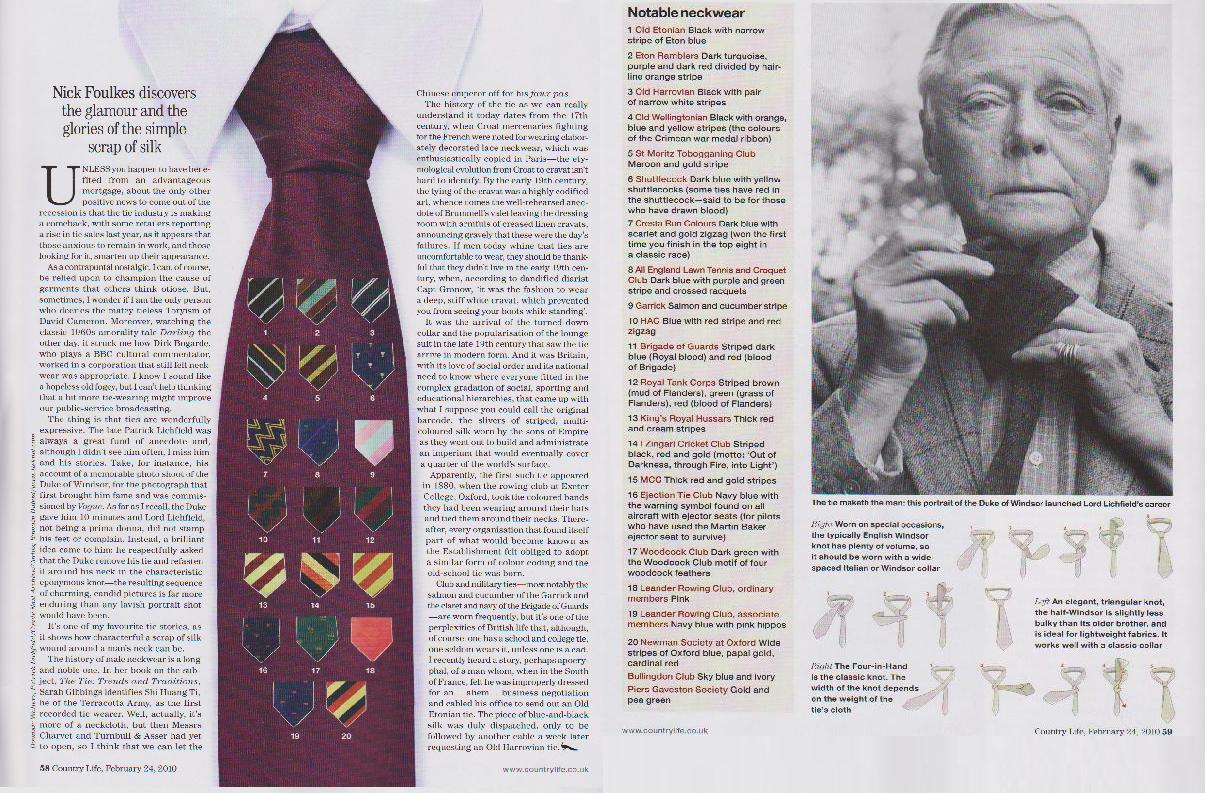
The brethren of the OW Lodge, in common with the brethren of fellow PSLC lodges, wear their old school ties in lodge, each with their distinct colours.

As the OW tie is restricted specifically to Old Boys, some brethren, notably the existing and former masters and servants of College that are not OWs, are not entitled to wear the tie, so the OW Society tie is also permitted, the Society having the wider constituency that includes all those who have served Wellington.

On the rare occasion that a member is not entitled to wear either Wellington tie, such as an honorary member, the wearing of their own school tie is also permitted.

Our guests too are welcome to sport their school colours.

The last custom with regard to ties relates to our Mother Lodge, Household Brigade. Members of that Lodge are welcome to wear the Household Brigade or Guards tie as they do in their own lodge, as a mark of respect from a Daughter to her Mother Lodge.

Household Brigade Old Wellingtonian OW Society

The pictures above highlight an interesting design quirk: For some reason, lost in the mists of time, or at least not known to any current OW, the stripes on the OW tie go the wrong way, in the direction of ‘one drawing one’s sword’, or bottom left to top right (from the wearer’s point of view).

This is contrary to accepted wisdom, ably demonstrated by that bastion of all things ordered and traditional, the Household Brigade, and a quirk shared only by Repton amongst the great public schools*. A guest from another school was heard to whisper that it was faintly American…

Before anyone gets too carried away by what at first may seem faintly improper, it is worth noting that several former and current regiments in the British Army share this design quirk, some of which are moderately respectable. They include the Royal Dragoons, the 5th Inniskilling Dragoon Guards, the Royal Hussars, both the 17th/21st and 16th/5th Lancers, the Buffs, the Argyles, several Fusilier and Light Infantry regiments, the Royal Signals, the Intelligence Corps and the Royal Marines.

So too does the RAF, although this may not be an entirely helpful argument in favour of propriety and tradition…

No Oxbridge college dares break ranks however, and only one of the ‘Ivy League’ universities follows the alleged Americanism, Yale. Should any further debate be required, it can be left in the hands of the members of Grays Inn, the only one of the Inns of Court whose tie also follows the ‘Wellington pattern’.

For a wider sample of PSLC school colours please see the excellent page on the Old Tauntonian Lodge website, and for a broader take on ties, see Nick Foulkes’ amusing article in Country Life below, which highlights another nonconformist tie, that of touring cricket club ‘I Zingari’. It also features a lesson in tying ties from a former honorary member of the OW Lodge, the Duke of Windsor.

As a postscript to this debate, it has been suggested that the real reason for this swathe of ‘sinister’ ties is in fact rather prosaic: the weaving technology then available in India at the time the various regimental messes sought to turn their colours into suitable neckwear was such that this direction of pattern was the only one available. The final conclusion should be left to the reader.

*although recently it has been possible to purchase Repton ties that go both ways.

Charity

Charity is one of the three pillars of Freemasonry.

Freemasons are taught to practise charity and to care, not only for their own, but also for the community as a whole – both by charitable giving, and by voluntary efforts and works as individuals.

The Old Wellingtonian Lodge has supported many worthy causes: those with links to Wellington, those with links to Freemasonry and those unrelated to either.

These include causes as diverse as:

We have also supported Wellington College in many ways, individually and collectively. Individual member’s bequests have seen the building of Pollock’s Bridge (named after Lodge Founder Dighton Pollock), which leads to Derby Field, acquired by and named after another Founder, the 17th Earl of Derby, and the relaying of the floorboards in Old Hall, bequeathed by Alfred Stanfield.

The Lodge has sponsored a number of projects and trips by members of College. We have also supported the Wellington charities  the Herbert Trust, the JL Bevir Memorial Fund (named in memory of Lodge member J L Bevir), and the OW Society Charitable Trust.

We also regularly support the four great Masonic charities which have recently become united under the banner of the Masonic Charitable Foundation whose site gives an insight into how Freemasonry is the second largest donor to charitable causes in the UK after the National Lottery.

For more information about London Freemasonry and Charity please see the Metropolitan Grand Lodge Website.

Lodge Family Tree

The Old Wellingtonian Lodge forms part of the Jerusalem Lodge No 197 family of lodges, via our mother lodge, the Household Brigade Lodge No 2614.

Our sister lodge is the Lodge of Assistance No 2773.

The family tree contains a number of school lodges, including the Old Rugbeians, the Old Bedfordians, and the Old Haileyburians, all fellow PSLC members, and the Old St Edwards Lodge No 5162 and the Old Eastbournian Lodge No 4946, once PSLC Lodges, now based in the Provinces of their schools.

Other ‘affinity’ lodges in the group include the Imperial College Lodge No 4536, and the youngest lodge in the group the Lodge of Marksmen No 9755 in Norfolk, which brings together brethren with an interest in clay pigeon shooting.

Please click on the image below to view as a whole page.

Metropolitan Grand Steward

The Old Wellingtonian Lodge would like to congratulate  W Bro Henry Hopking on being invested as a Metropolitan Grand Steward by the Metropolitan Grand Master on Thursday 1 March 2012. 

Connaught Jewel

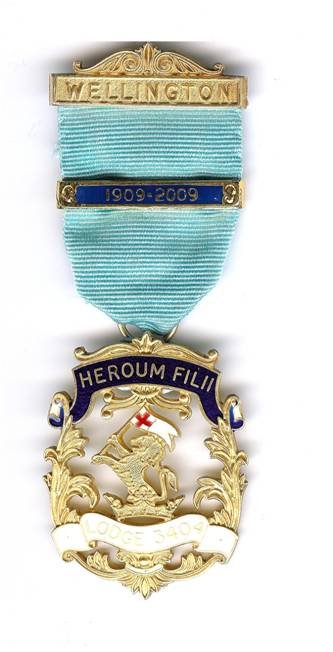
On 4 July 1911 the Grand Master HRH the Duke of Connaught and Strathearn, the Worshipful Master of the Old Wellingtonian Lodge, granted this Lodge a unique members’ jewel, to be known as the ‘Connaught Jewel’, and decreed that it be worn at “all Masonic meetings”.

The Connaught Jewel is one of three jewels offered to members of the Lodge, the others being our Past Master’s Jewel and the Founder’s Jewel (although the last of our founders Brig S V P Weston passed away in 1973). All three appear below.

The Connaught Jewel comprises the lion rampant of the Duke of Wellington, together with the original name (‘Heroum Fillii’) and our lodge number appended to a pale blue ribbon.

The Lodge is believed to be one of approximately 70 lodges under the English Constitution to have a members’ jewel (click here for more information on members’ jewels), and one of only nine to have one bestowed upon it by a member of the Royal Family.

It is not however a Royal Jewel (of which there are only three), but one of six awarded by Grand Masters. The Duke of Connaught bestowed four such jewels – to Aldershot Army & Navy Lodge, London Irish Rifles Lodge, Household Brigade Lodge and to the Old Wellingtonian Lodge. The former two lodges’ jewels are restricted to Master Masons, whereas the Old Wellingtonian’s Connaught Jewel and the Household Brigade jewels are for all members of the respective lodges.

The Grand Secretary at the time Sir Edward Letchworth, an honorary member of the Lodge, issued a certificate detailing the design and nature of the Jewel, and the rights of Lodge members to wear it, copies of which are still issued to all members when they get their jewels.

As a final note we do not have a centenary jewel (like this one), having instead a centenary bar on the ribbon of the Connaught Jewel. This is in part to stop members sporting the ‘Russian general look‘ and clanking their way through Lodge meetings….

Founder’s Jewel

Connaught Jewel

Past Master’s Jewel

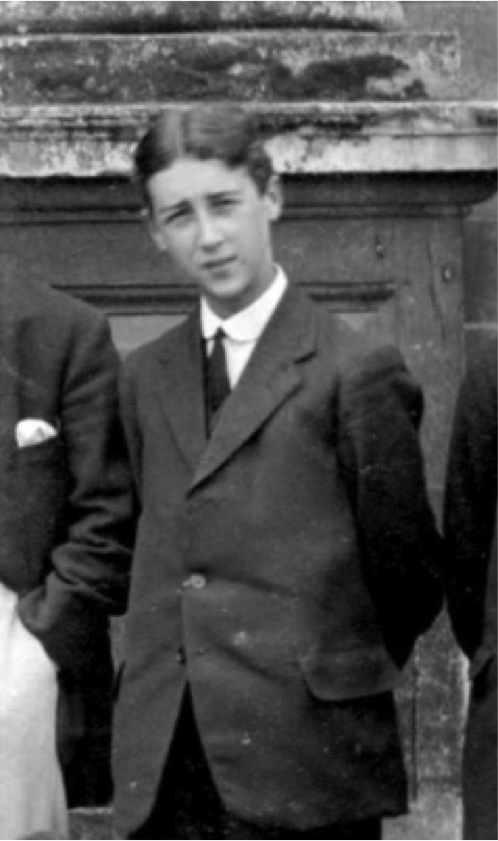
G J Carter

Godfrey Jackson Carter was in the Hill from 1925, and played for the 2nd XV (image above courtesy of the Wellington College Archive), before studying engineering at Birmingham University before going to the D.H. Technical School and then joining the De Havilland Aircraft Company. He started as a fitter in 1933, before transferring to the inspection department in 1936, and becoming a supervisor in 1938.

The war saw him become a supervisor of the flight shed.[1] He was Killed on Active Service in 1943, just five days after Henry Garratt.

A seven-year-old eyewitness recalls the tragic accident on 23 August 1943, approximately three miles east-south-east of St Albans[2]:

“I remember looking up and seeing a Mosquito coming towards us from the west. We then spotted another one coming from the opposite direction. They appeared to be at the same height and they were travelling very fast. Someone cried “My God, they’re going to crash!” and a split second later they did – pretty well head on. The sound of the impact made a sharp crack. The aircraft disintegrated into a myriad of small pieces, most of which floated down uncannily slowly as the aircraft were made of wood. To my seven-year-old eyes one fragment was shaped just like a model glider. There was one open parachute.”[3]

The aircraft were Mosquito Mark VI fighter bombers, numbers HX849 and HX850, on test flights from Hatfield, the De Havilland aerodrome. The pilots were John de Havilland, younger son of the company’s founder Geoffrey de Havilland, and George Gibbins. JHF Scrope and Godfrey Carter were the respective observers. There were no survivors, the parachute belonged John de Havilland who died on the way to hospital .[4]

Carter was 32.

____________________

[1] Flight Magazine 02-09-1943

[4] ‘Mosquito, the Illustrated History’ Philip J.Birtles

H G C Garratt

HGC Garratt Beresford 1916 (courtesy of Wellington College Archive)

Major Henry George Cashel Garratt went to Wellington in 1916, to the Beresford. It is the Beresford House photograph in his first year that is the source of the above photograph. He went to Sandhurst and was commissioned in 1923 into the Royal Ulster Rifles which he served until 1926. He transferred to the reserve in 1925, rejoining the Royal Inniskilling Fusiliers at the outbreak of war.

He joined the 6th Battalion (the “6th Skins”), part of 38th (Irish) Brigade in North Africa on 27 April 1943 at Kef El Tiour and took part in the invasion of Sicily where he was wounded and died from wounds received in the pursuit towards Randazzo on 18 August 1943, the last battle in the liberation of Sicily. He is buried in Catania Cemetery.[1]

The unit war diary for the morning of 13 August 1943 records:

“0130 Remainder of Bttn, with A Coy leading, followed by Bttn HQ. C Coy moved off down the road. When about 3 miles from the final objective (810190), the leading platoons of B Coy under Lieut Bolton ran into an ambush, three were killed and four seriously wounded by about 4 MG 34s. The reason why this platoon had got so far ahead was because the main body of the coy had encountered a number of S mines. Major HGC Garratt was wounded. They became so numerous that the CO decided to leave the road. The remaining three miles were over most difficult country. Vineyards with every now and then very high stone walls and terraces. The last mile was over a very open patch of lava, which in the darkness was very difficult to negotiate. It was impossible for mules even to follow up and they were left to follow up in daylight. The rear link also had to be left behind for the last mile. Two miserable PoWs were taken during the advance. At dawn, the Bttn got back on the road and continued to advance somewhat faster. A detour had to be made at one point to avoid running into some shell fire put down by Americans….”

Garratt joined the OW Lodge in 1938, having been initiated into Cadogan Lodge No 162 in London.

[1] Reference: IV. F. 12